Buffett’s Pick for the AI Era: Google Alphabet, a Digital Powerhouse Like Coca-Cola

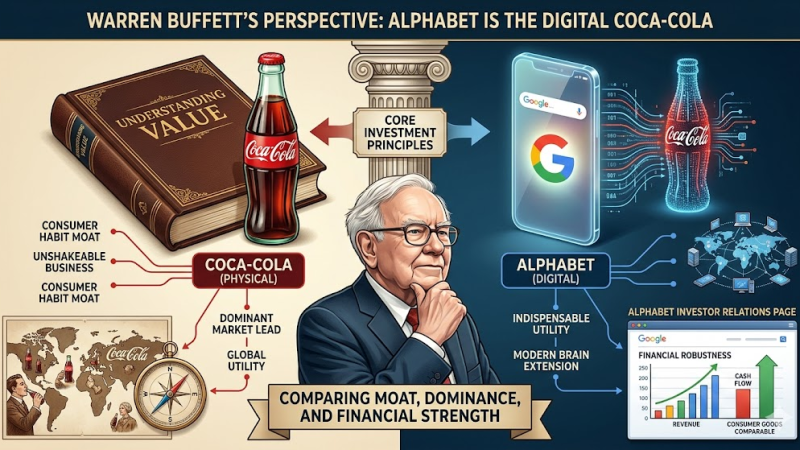
Executive Summary: Alphabet (Google) represents the pinnacle of digital assets, maintaining a brand moat as formidable as Coca-Cola through its overwhelming search market share and proprietary YouTube data. Through vertical integration, the company generates structural competitive advantages and immense Free Cash Flow (FCF), securing its dominance in the AI era.
Lately, the stock market and the tech industry have been flooded with provocative narratives, such as “the sun is setting on Google” or “new AI chatbots will completely replace the traditional search bar.” In the face of such loud market noise, we must remain humble and constantly question our own judgment.
We often make the mistake of being blinded by flashy new technologies, missing the underlying essence of the business. A truly great company, much like Coca-Cola, embeds itself into the daily lives of the public, creating a structure that quietly generates massive amounts of cash. This article is not a blind eulogy for Alphabet, but rather an in-depth analysis of its fundamental strength and its “Coca-Cola-like” structural superiority.
1. Alphabet through the Lens of Warren Buffett: The Coca-Cola of the Digital Age
The legendary investor Warren Buffett favors companies he can perfectly understand—those with business models that remain unshakable despite changing times and possess overwhelming market dominance. One of the companies he has loved and held for the long term is Coca-Cola, which has captured the world’s palate. Google’s search engine is fundamentally no different from the “habit moat” established by Coca-Cola.
In fact, Google is closer to a massive, powerful toll road sitting at the very foundation of the world’s internet infrastructure. When we seek information or need to learn something, we subconsciously open our smartphones and turn to Google—the same way Coca-Cola became the absolute synonym for quenching thirst. Functioning as an extension of the modern human brain, Google serves as an essential utility deeply rooted in global daily life.
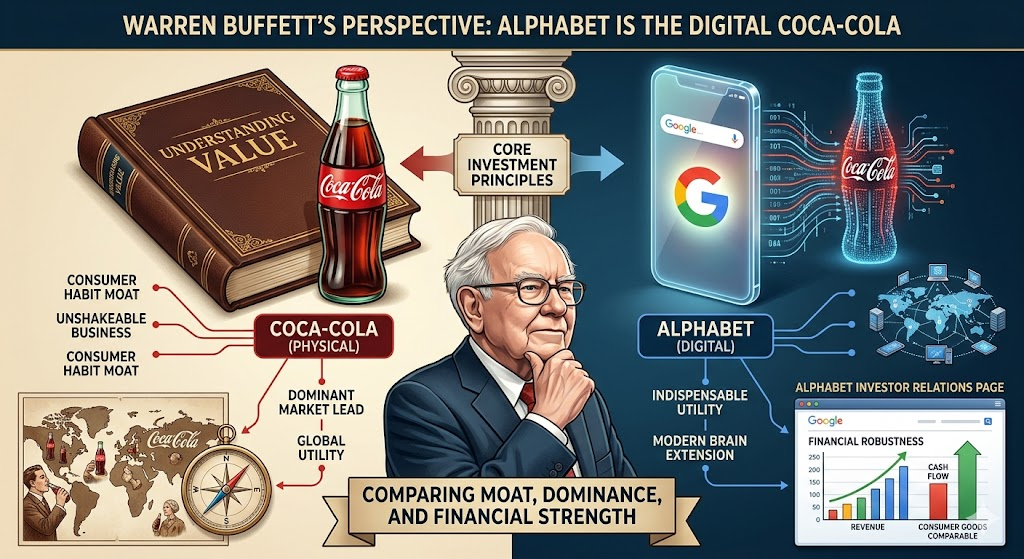
A look at the financial statements on the Alphabet Investor Relations official page clearly shows that their financial robustness surpasses even that of traditional consumer staples.
2. The First Pillar: AI Energy Security and Infrastructure Dominance
The true strength of Google lies in its complete internalization of the entire AI value chain, eliminating external dependencies. This is very similar to how Coca-Cola maximizes profits by controlling everything from concentrate manufacturing to bottling and global distribution. Google’s proactive strategy regarding “power”—widely cited as the biggest physical bottleneck for AI industry growth—is particularly peerless.
Generative AI consumes at least ten times more power than traditional simple searches. Big Tech companies that fail to solve this issue will inevitably fall behind. Google is pouring astronomical capital into Small Modular Reactor (SMR) technology to secure the carbon-free energy needed to run its massive data centers 24/7. Unlike solar or wind power, which are weather-dependent, SMRs are regarded as the only alternative capable of providing stable baseload power 365 days a year.
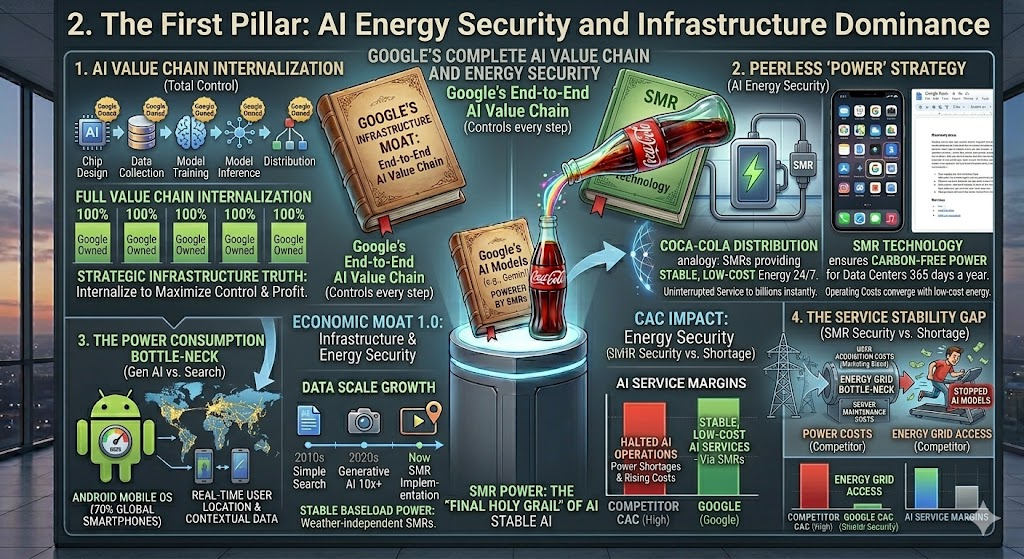
Establishing this energy security acts as the strongest shield for Google’s corporate value. While competitors may have to halt AI model operations due to power shortages and rising costs, Google will be able to provide stable, low-cost services via SMRs. This is identical to Coca-Cola’s ability to reliably supply its beverages worldwide regardless of economic crises or logistics collapses.
3. The Second Pillar: The Foresight of TPUs—Beyond Coca-Cola’s Secret Recipe
While NVIDIA’s GPUs currently monopolize the hardware market for training and inferring AI models, Google foresaw this situation a decade ago. Google has been developing its own AI-specific semiconductor, the TPU (Tensor Processing Unit), since 2015 and has integrated it into its data center infrastructure. This is a powerful economic moat, akin to Coca-Cola owning its secret recipe to remain completely free from the pricing pressures of external raw materials.
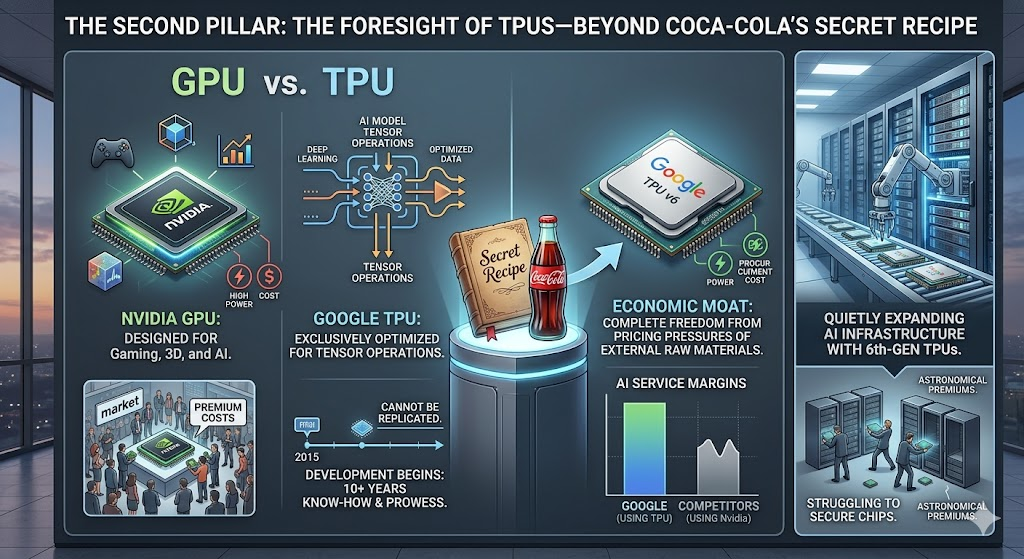
Unlike NVIDIA’s GPUs, which are designed for general-purpose use like gaming, Google’s TPUs are custom chips optimized exclusively for “tensor operations,” the core of deep learning. Consequently, Google can drastically reduce semiconductor procurement costs and power consumption when training and servicing hyper-scale AI models compared to its competitors. The TPU architecture know-how and technological prowess accumulated over the past ten years cannot be replicated by latecomers simply by throwing capital at the problem.
While other Big Tech firms struggle to secure NVIDIA chips even at astronomical premiums, Google is quietly expanding its AI infrastructure using its 6th-generation TPUs. This hardware independence is a key driver protecting Google’s AI service margins, much like how Coca-Cola uses its overwhelming cost competitiveness to price out other brands.
4. The Third Pillar: YouTube Video Data—The Concentrate and Holy Grail of AI
The core ingredient that determines success or failure in the AI era is undoubtedly high-quality data. We are fast approaching a future where human-produced text data will be exhausted. Google fully owns YouTube, the world’s most dominant and irreplaceable mine of video data. The vast audiovisual data on YouTube is a unique resource for Google—much like Coca-Cola’s concentrate—that others can never imitate or buy.
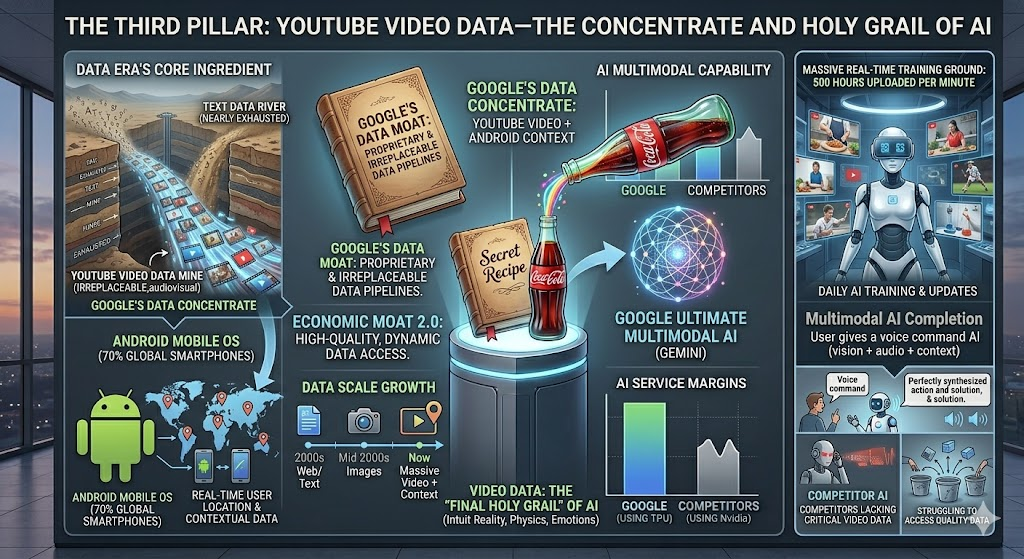
While text-based data is excellent for logically summarizing human knowledge, it cannot teach AI about three-dimensional reality, such as the laws of physics, emotions, or spatial awareness. YouTube video data, which combines video and audio, is called the “Final Holy Grail” that allows AI to understand the world intuitively and three-dimensionally. With 500 hours of video uploaded every minute, YouTube is a massive, real-time training ground for AI that updates daily.
Furthermore, Android—the mobile operating system installed on 70% of smartphones worldwide—collects real-time user location and contextual information. These two massive pipelines (YouTube’s dynamic data and Android’s contextual data) are as robust as Coca-Cola’s global market share. Based on this proprietary data, Google is completing the ultimate Multimodal AI that competitors dare not approach.
5. The Fourth Pillar: The Distribution Moat and Universal Accessibility
A painful truth in the consumer goods market is that no matter how great a product is, it won’t sell if it isn’t right in front of people. Google is an unprecedented company that owns the world’s widest and most accessible “digital shelves.” It has six services—including Chrome, Gmail, and Google Maps—each used by over a billion people daily.
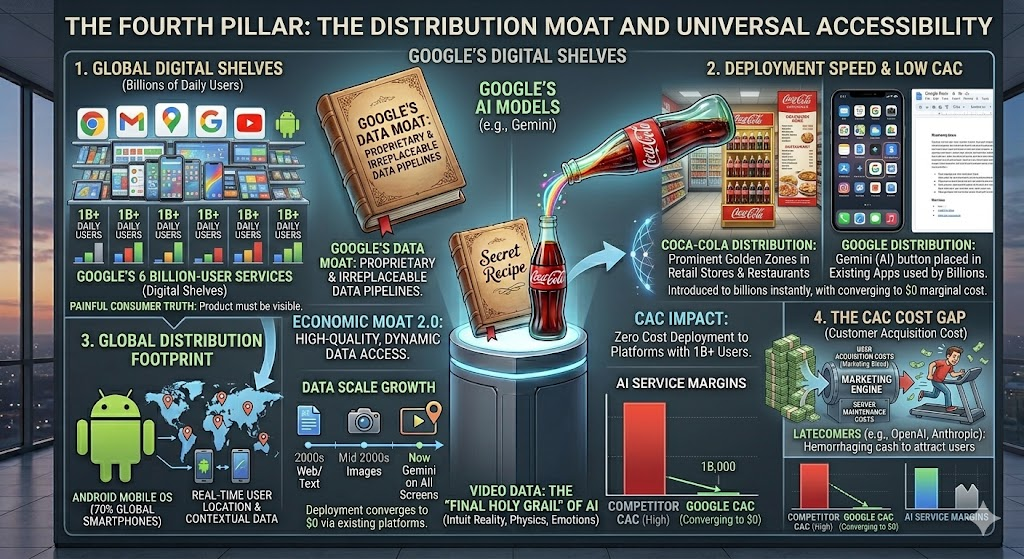
When Google introduces cutting-edge AI models like Gemini to the public, they incur almost zero additional Customer Acquisition Cost (CAC). They simply need to quietly place an AI call button on the smartphone home screens or the top-right corner of Google Docs that billions of people are already using. This is the explosive power of distribution, perfectly matching how Coca-Cola is displayed in the most prominent “Golden Zones” of any convenience store or restaurant in the world.
AI latecomers like OpenAI or Anthropic are forced to bleed cash on massive marketing and server maintenance costs to attract users. In contrast, Google can deploy its AI ecosystem to billions of users instantly with a marginal distribution cost that essentially converges to $0, just like Coca-Cola.
6. The Investor’s Yardstick: A Valuation Based on FCF More Attractive than Coca-Cola
As of May 2026, Alphabet’s Forward P/E ratio is trading at approximately 23–25x, driven by the successful monetization of AI services and the steep growth of its Cloud division. The PEG ratio, which reflects earnings growth, stands at 1.2–1.3, remaining the most reasonable metric among major Big Tech companies. Compared to the P/E multiple of Coca-Cola (approx. 24–26x)—a traditional value stock with steady but slow growth—Alphabet remains undervalued when considering its explosive scalability as a tech stock.
Market concerns regarding “search ad erosion by AI” have now transformed into confidence as the synergy between search advertising and generative AI is confirmed. A wise investor should look beyond accounting net income and focus on Free Cash Flow (FCF)—the actual cash the company puts in the bank. While continuing massive Capital Expenditure (CapEx) for 6G preparation and hyper-scale AI infrastructure, Alphabet generates tens of billions of dollars in FCF every quarter, providing a rock-solid margin of safety.
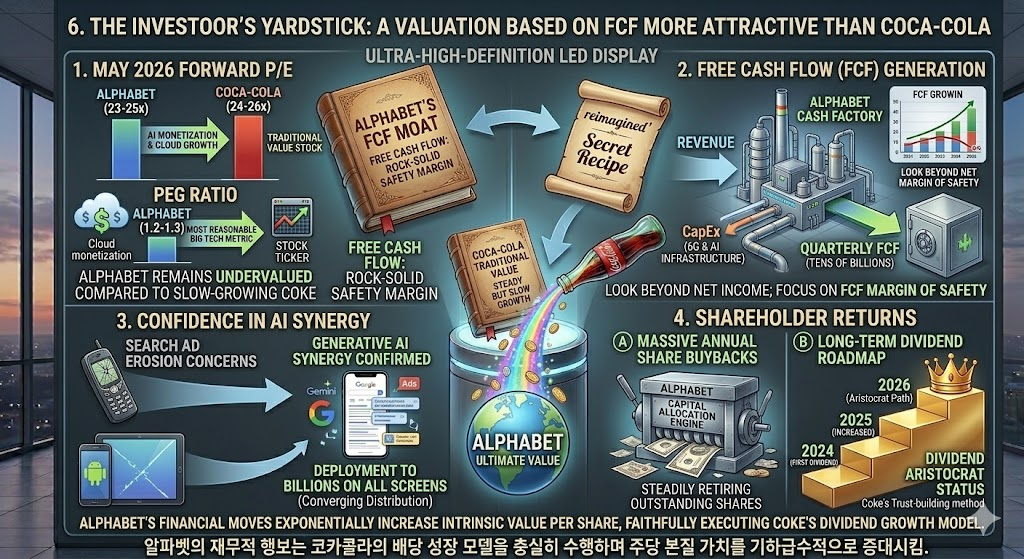
This abundant cash flow serves as both the ammunition for the intelligent cloud wars and the engine for aggressive shareholder returns. Alphabet uses this massive surplus to execute tens of billions of dollars in share buybacks annually, steadily retiring outstanding shares. Since its first dividend payment in 2024, Alphabet has consistently increased its dividend through 2026, faithfully executing its long-term roadmap to join the ranks of “Dividend Aristocrats.”
These financial moves, which exponentially increase the intrinsic value per share, prove that Alphabet is perfectly replicating the trust-building methods Coca-Cola has used for decades through dividend growth—more so than any other tech stock.
7. Conclusion: The Humble Wisdom of the AI Era and the Lessons of Coca-Cola
No matter how fast cutting-edge AI technology evolves or how much innovative trends fluctuate, people’s basic search habits and YouTube viewing patterns do not change overnight. Beyond being a mere software tech company, Google has firmly established itself as the “Digital Coca-Cola,” deeply rooted in human daily life and cognitive structures. It is a historical truth of consumption that the public does not easily abandon comfortable, long-standing habits just because a new alternative technology emerges.
We do not need to gamble on risky startups or lose sleep over volatile daily charts to find the leader of the next era. One only needs to own and walk alongside a giant company that generates overwhelming cash, evolves through crises, and completely controls essential infrastructure—at a reasonable price. Much like the certain comfort a can of Coca-Cola provides on a hot summer day, Google within an investment portfolio will serve as a reliable and comfortable mainstay.
Just as the public’s habit of drinking Coca-Cola has remained unshaken for nearly a century, Google’s robust ecosystem will only grow stronger as it rides the massive wave of AI. For the patient investor who understands true business value and maintains a long-term perspective, Google is the ultimate asset. In a highly volatile stock market, Google will deliver great long-term compounding returns as the unwavering Digital Coca-Cola.
이 콘텐츠의 이미지는 AI 모델의 지원을 받아 생성되었습니다.