Innovative Changes and Investment Opportunities in Physical AI

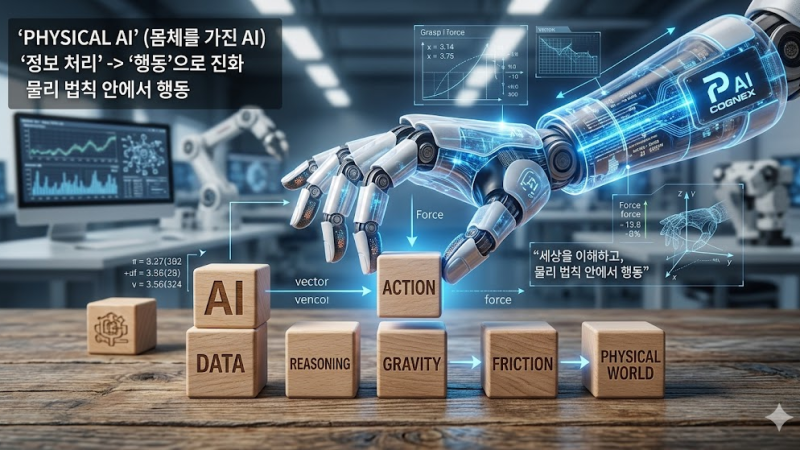
- Physical AI is AI that moves beyond digital spaces to act directly in the physical world, fundamentally differing from traditional industrial robots.
- The system architecture is divided into three layers — ① Brain (AI chips/software), ② Sensory Organs (cameras, LiDAR, tactile sensors), and ③ Body (reducers, motors, actuators).
- The market will open in stages: Short-term (logistics, manufacturing), Mid-term (construction, agriculture, healthcare), and Long-term (household, elderly care).
- Big Tech companies like Amazon, BMW, and Tesla have begun deploying robots in actual work environments — it is no longer just a concept; the direction of capital is shifting.
- Hardware costs are falling rapidly — the Unitree G1 is priced at $16,000, and Tesla’s goal for Optimus is under $20,000.
- Investors should focus on companies that simultaneously possess three elements: AI software, hardware, and real-world training data (e.g., Tesla, Boston Dynamics).
- The component supply chain may be more stable than the competition for finished products — precision reducers, motors, and platforms are the key bottlenecks.
- There are three main uncertainties — mass production yield, AI model stability/regulation, and the speed of China’s cost disruption.
- Investors should approach the market by identifying which layer—finished product, component, or platform—is experiencing structural bottlenecks.
- This market carries high uncertainty. For an investor, the starting point is to honestly distinguish between what they understand and what they do not.
Introduction — The “Robot” Misconception
Most people who first encounter the term Physical AI stop thinking as soon as they hear the word “robot.” They picture the Terminator from the movies or industrial mechanical arms welding on a factory line. Usually, this is followed by the reaction: “Wait, isn’t that old news?”
The Physical AI currently under discussion is fundamentally different from previous generations of industrial robots. Robots of the past only repeated precisely programmed movements. A machine designed to tighten bolts would tighten bolts forever; it had no concept of picking up a screw rolling right next to it.
However, over the last two to three years, this premise has begun to shift. The advancement of Large Language Models (LLMs) has created general-purpose AI models capable of serving as a robot’s “brain,” and these models are starting to be implemented through physical bodies with arms and legs. We are seeing robots that can execute the natural language command “Fold the laundry” by judging and moving on their own, even in unfamiliar environments.
It is still too early to judge whether this is a simple technological advancement or a full-scale paradigm shift. However, from an investor’s perspective, there are several signals making this trend increasingly difficult to ignore.
What is Physical AI? — Let’s Start with the Definition
“Physical AI” is not yet a term with a fully unified academic definition. However, the context commonly used in the industry is relatively clear: it refers to a system where AI, which previously operated only within digital spaces, acts directly in the real world through a physical body.
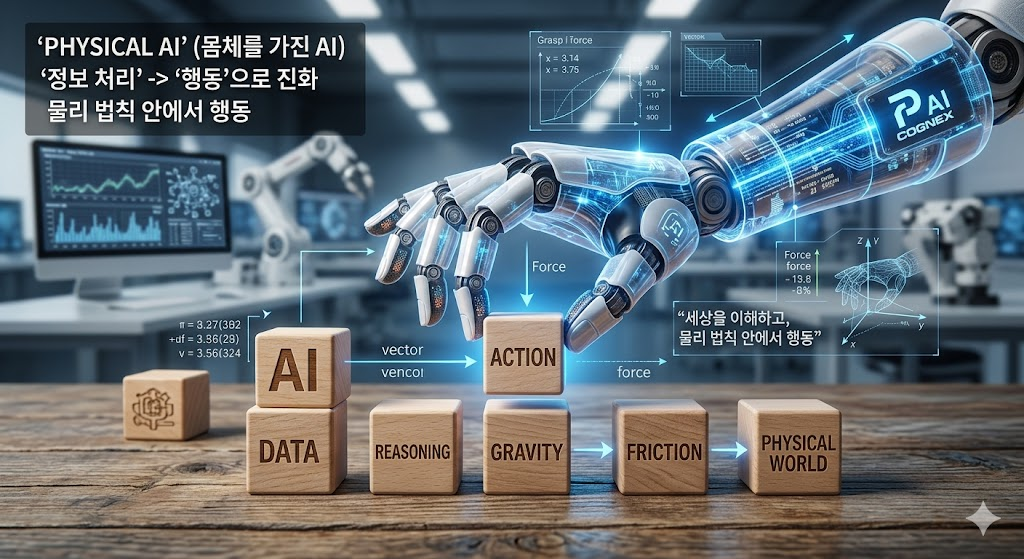
Traditional AI focused on “information processing,” such as generating text, creating images, or writing code. Physical AI goes one step further to perform “actions”—picking up objects, moving, assembling, and changing the environment based on its judgment. This is the core difference.
Nvidia’s Jensen Huang described Physical AI as “AI that can understand the world, reason, and act within the laws of physics.”
The critical part of this definition is “within the laws of physics.” AI on a screen does not know gravity. Physical AI must apply more force if an object is heavy and adjust its grip strength if a surface is slippery. This is an incredibly difficult problem, much more so than it might seem.
The Architecture of Physical AI — What Is It Made Of?
The Physical AI system can be categorized into three main layers. Understanding this structure makes it much clearer where the investment opportunities lie.
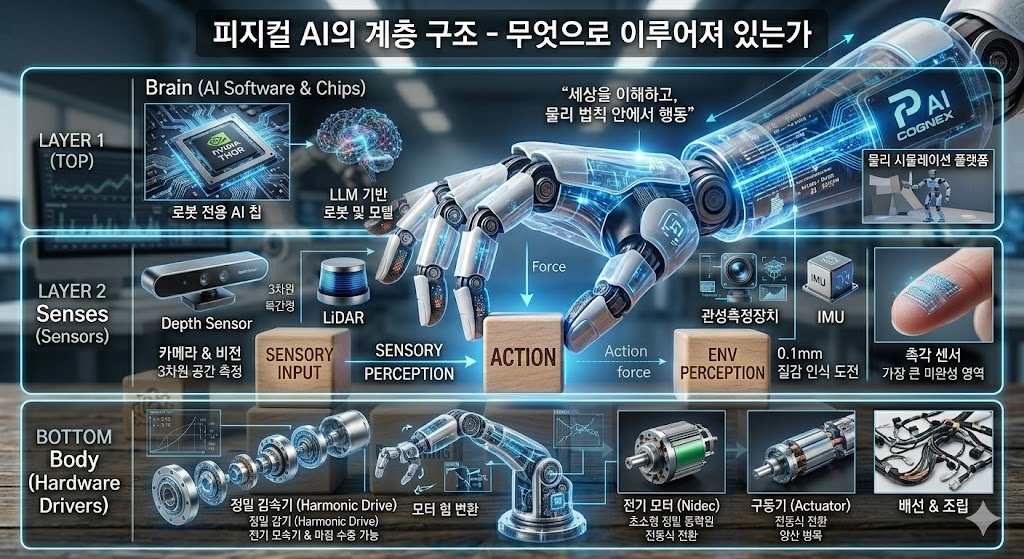
The First Layer — The Brain (AI Software & Chips)
This is the core that allows the robot to perceive its environment and make decisions. It processes data coming in from cameras and sensors in real-time to decide, “What should I do in this situation?” This is where Large Language Model-based Robot Foundation Models come into play.
NVIDIA dominates this layer. Through its Thor (a dedicated robot chip) and the Isaac simulation platform, most Physical AI companies are currently developing on NVIDIA’s infrastructure. This is because training robots in a physical simulation environment is far faster and cheaper than operating thousands of physical robots.
The Second Layer — Sensory Organs (Sensors)
These correspond to the eyes and skin through which the robot perceives the world.
- Cameras & Machine Vision: Used for visual recognition of the environment. Companies like Cognex and Keyence have led this field for a long time.
- LiDAR & Depth Sensors: These precisely measure 3D space. Technologies proven in autonomous driving are now being transferred to robotics.
- Tactile Sensors: Currently the greatest “unfinished” area of Physical AI. While human fingers can sense texture differences of less than 0.1mm, replicating this in a robot remains technically very difficult. This is why tasks like picking up an egg without breaking it or applying the right amount of force to a glass are more complex than they seem.
- IMU (Inertial Measurement Unit): Enables the robot to maintain balance and recognize its own posture.
The Third Layer — The Body (Hardware Actuation)
This is the component that converts the brain’s decisions into actual physical movement.
- Precision Reducers (Harmonic Drive / Reducer): The core component of robot joints. They convert the high-speed rotation of an electric motor into slow, powerful torque. Because they require decades of precision machining expertise, increasing supply in the short term is difficult. Japan’s Harmonic Drive Systems and Nabtesco dominate most of the global market.
- Electric Motors: The power source for all movement. Nidec, the world leader in ultra-small precision motors, is a key supplier.
- Actuators: Devices that create linear or rotary motion. Recently, there has been a rapid transition from traditional hydraulic systems to electric ones.
- Wiring & Assembly: The task of connecting hundreds of cables and connectors inside the robot. This is currently one of the biggest bottlenecks in mass production. Ironically, this is still the part of robot manufacturing that requires the most manual human labor.
Where is Physical AI Used? — The Landscape of Application
The potential applications for Physical AI theoretically span every domain where humans use their hands and feet. However, in reality, the market is expected to open in stages based on economic viability and technological maturity.
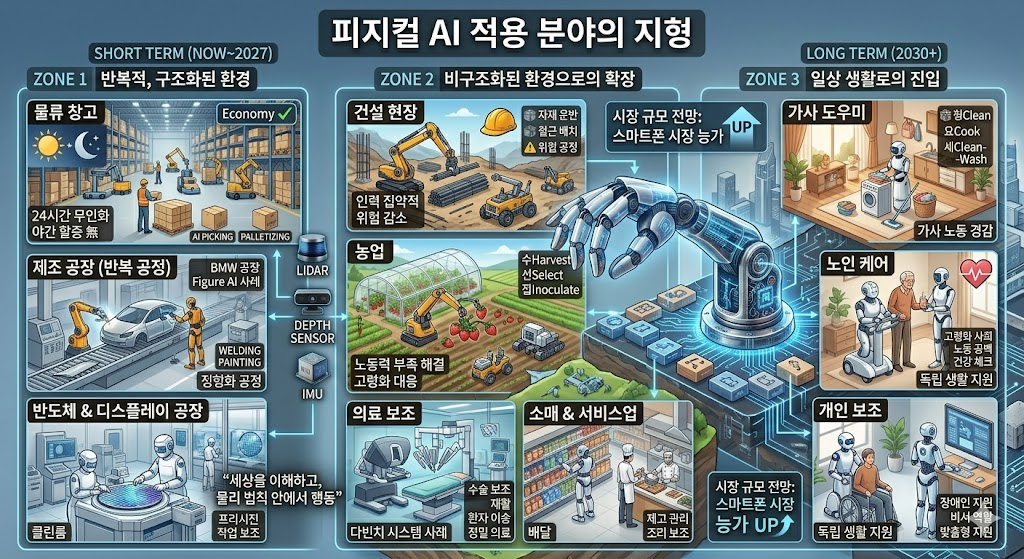
Short-term (Now–2027): Repetitive, Structured Environments
This domain has already entered the commercial deployment phase. Economic viability is achieved most quickly in areas where the environment is consistent and tasks are repetitive.
- Logistics Warehouses: Large logistics firms like Amazon and DHL are aggressively adopting picking and palletizing robots. The ability to operate 24/7 without night-shift premiums provides strong economic justification.
- Manufacturing Plants (Repetitive Processes): Robots are prioritized for standardized processes such as welding, painting, and screw tightening. The deployment of Figure AI robots in BMW factories is a representative example.
- Semiconductor & Display Factories: Precision task assistance within cleanroom environments.
Mid-term (2027–2030): Expansion into Unstructured Environments
The market will explode once AI can respond to situations where the work environment changes every time.
- Construction Sites: Labor-intensive and hazardous processes such as material transport, rebar placement, and finishing work.
- Agriculture: Harvesting, sorting, and grafting—sectors facing severe labor shortages due to an aging skilled workforce.
- Healthcare Support: Surgical assistance, rehabilitation, and patient transport. Intuitive Surgical’s Da Vinci system has already pioneered the surgical robot market.
- Retail & Service Industry: Inventory management, food preparation assistance, and delivery.
Long-term (After 2030): Integration into Daily Life
This is the most difficult yet largest potential market. Some forecast that once domestic robots are commercialized, the market size could surpass that of the current smartphone industry. However, this area currently faces the highest technical and economic uncertainty.
- Domestic Assistants: Cleaning, cooking, and organizing laundry.
- Elderly Care: Addressing the most urgent labor gap in aging societies.
- Personal Assistance: Support for people with disabilities and acting as personal assistants.
What signals are being detected in the Physical AI industry?
Signal 1 — Big Tech is Putting Skin in the Game
In the world of investing, a question far more critical than “Is this technology innovative?” is “Who is actually spending money on it?”
Currently, Amazon has deployed Agility Robotics’ Digit robots in its fulfillment centers. BMW has integrated Figure AI robots into its production lines. Tesla is utilizing Optimus robots for actual tasks within its own Gigafactories. The crucial point here is that these are not mere demos or PR stunts; they are operational deployments in real work environments.
While the current scale remains modest, the fact that these giants have begun executing capital expenditures suggests that Physical AI is transitioning from “a future that might come” to “a reality we must prepare for now.” As the history of investing repeatedly shows, when the direction of CapEx shifts, those who read that direction first are the ones who capture the returns.
Signal 2 — Hardware Costs are Collapsing Faster Than Expected
No matter how superior a technology is, widespread adoption won’t happen if the cost cannot clear the market threshold. In this regard, recent cost trends are remarkable.
Just three years ago, a single humanoid robot cost hundreds of thousands of dollars, with some research models priced even higher. At that price point, there are no buyers outside of major corporate labs or a tiny handful of experimental pilot programs.
However, China’s Unitree Robotics launched the G1 model in 2024 at approximately $16,000. Tesla has set a mass-production target price for Optimus at under $20,000. Assuming a robot can replace a single human worker for simple, repetitive tasks, the economic math for robot adoption is entering a realistic territory for the first time.
Of course, this is a simplified comparison. There are many more variables to consider—maintenance costs, software updates, the scope of applicable tasks, and actual production yield issues. However, the trajectory itself is clear: the cost curve is trending sharply downward.
If you remember the early days of Electric Vehicles (EVs), this pattern will feel very familiar
How to View the Investment Landscape — Who Holds Which Cards?
I believe the dominance in Physical AI will be determined by three primary factors: AI software capability, hardware manufacturing capacity, and real-world training data. Companies that possess all three simultaneously are highly likely to hold a strategic advantage in the long run.
At this point, Tesla (TSLA) is the publicly traded company closest to internalizing all three elements. They combine their proprietary AI chips (Dojo supercomputer), hardware manufacturing power built on Gigafactories, and real-world driving data collected daily from millions of vehicles. This data asset could become a true “moat,” as it is something competitors cannot simply replicate with money in a short period.
However, evaluations of Tesla always swing between two extremes. The appropriate valuation changes entirely depending on whether you view them as a car company or an AI/Robotics firm. One must approach this while acknowledging such uncertainty.
The Component Supply Chain — Sometimes Selling the Shovels is Better Than Digging for Gold
It is a timeless piece of investment wisdom that during a gold rush, the person selling pickaxes often makes more consistent money than the person digging for gold. I believe this perspective is highly valid for Physical AI as well.
At this stage, it is impossible to know which company will eventually dominate the finished humanoid robot market. However, no matter who builds the robot, the precision reducers that move its joints are an absolute necessity. Japan’s Harmonic Drive Systems and Nabtesco possess decades of accumulated technical expertise and market share in this field. The production know-how for these components is incredibly difficult to replicate in a short timeframe. In the Korean market, SBB Tech draws attention as the only company producing harmonic reducers.
In the field of Machine Vision, which allows robots to perceive their environment, Cognex has maintained a dominant position for a long time. As Physical AI moves beyond the factory floor, the application range for this technology will expand even further.
Furthermore, regardless of which robot company wins the race, NVIDIA is guaranteed a baseline of benefits as the provider of AI chips and simulation platforms. Most Physical AI startups are currently utilizing NVIDIA’s Isaac simulation platform and Thor dedicated robotics chips.
Of course, this does not mean all these companies are guaranteed to be good investments. Their current stock prices may already fully reflect these expectations, and the technological landscape could evolve in a direction different from what we anticipate.
Uncertainties in the Market
While acknowledging the potential of Physical AI, it is important to honestly address several lingering uncertainties.
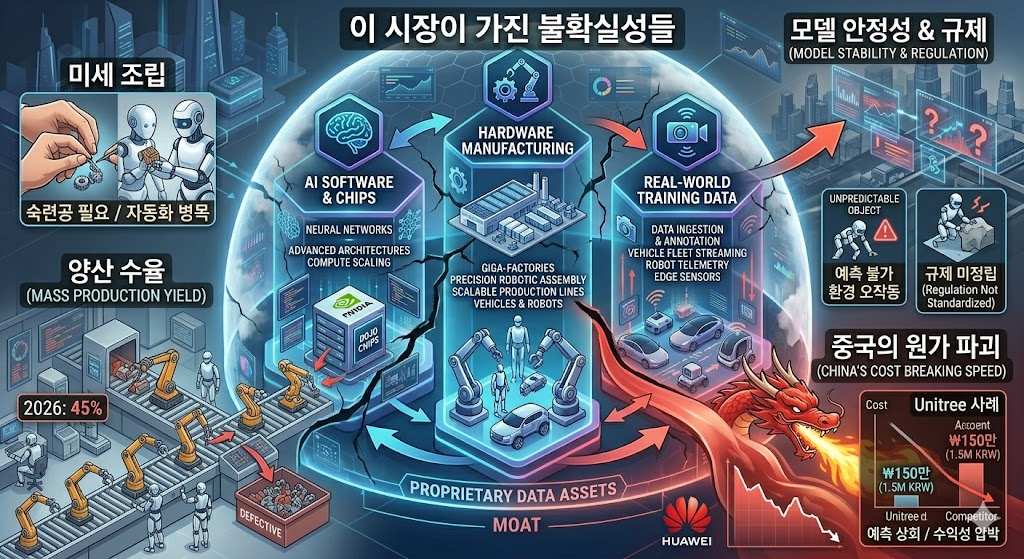
Market Uncertainties
While we embrace the potential of Physical AI, we must candidly address several lingering uncertainties.
1. Mass Production Yield and Manufacturing Hurdles
The most significant variable is mass production yield. There is always an unforeseen barrier when transitioning an idea or prototype into large-scale manufacturing. Currently, many Physical AI companies remain in the small-scale deployment phase. Physical processes—such as internal wiring and precision micro-assembly—still frequently require the touch of a skilled human hand. Consequently, the path to fully automated mass production may be longer than anticipated.
2. Stability of AI Models and Regulatory Response
The second concern is the stability of AI models. Clear frameworks for liability and regulatory compliance have yet to be established for cases where general-purpose AI robots malfunction in unpredictable, real-world environments. This legal and ethical ambiguity could act as a major friction point, slowing the pace of widespread adoption.
3. The Speed of China’s Cost Disruption
The third factor is the unprecedented speed of cost reduction coming from China. As seen with Unitree, the ability of Chinese firms to slash production costs has repeatedly exceeded Western projections. It remains to be seen whether this will act as a catalyst to expand the overall Physical AI ecosystem “pie,” or if it will primarily serve to squeeze the profitability of established global players.
Conclusion — What Questions Should Investors Ask?
It is becoming increasingly clear that Physical AI is a massive trend. Big Tech capital is in motion, cost curves are trending downward, and early commercial deployments have commenced.
However, uncertainty persists regarding when, around which companies, and at what speed this market will grow. If this uncertainty feels uncomfortable, it may not be the time to dive deep into this sector. On the other hand, if you view this uncertainty as an opportunity, it is rational to approach the market by identifying where the most structural bottlenecks exist—whether in finished products, components, or platforms.
Investing is ultimately about forming hypotheses and placing bets within a range where you can withstand the losses if those hypotheses prove wrong. Before forming a hypothesis about Physical AI, an investor must honestly distinguish between what they understand and what they do not. That is the best starting point.
I, too, am still in the process of studying this market.
이 콘텐츠의 이미지는 AI 모델의 지원을 받아 생성되었습니다.