AI 5-Layer Cake: Structure and Industry Analysis by NVIDIA CEO Jensen Huang

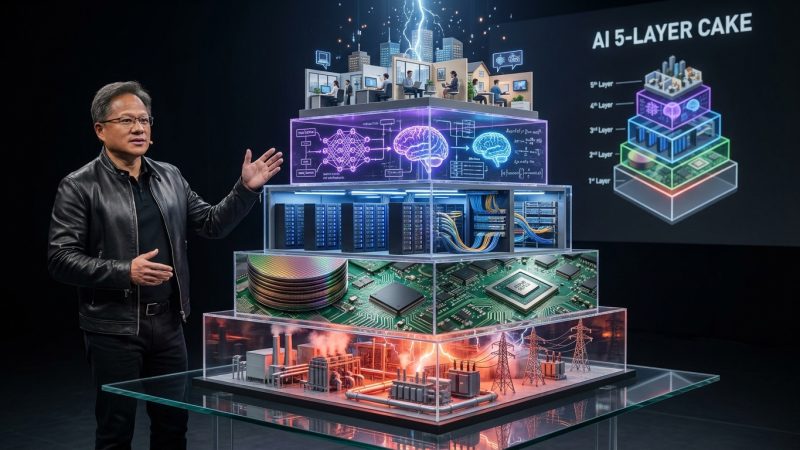
AI 5-Layer Cake: Structure and Industry Analysis
[Summary] AI is not merely software; it is a massive, capital-intensive physical industrial framework dubbed the “5-Layer Cake.”
- Layer 1 – Energy: The fundamental base and a major bottleneck. Securing power for data centers and advanced cooling systems is critical, placing energy providers (nuclear, renewable, etc.) at the forefront of the industry.
- Layer 2 – Chips: The essential “brain” of AI. NVIDIA’s GPUs, supported by High Bandwidth Memory (HBM) from leaders like Samsung Electronics and SK Hynix, determine the speed and efficiency of AI computation.
- Layer 3 – Infrastructure: The “AI Factory.” Cloud giants are engaged in a fierce networking standard war (InfiniBand vs. Ethernet) to connect thousands of chips via ultra-low latency links.
- Layer 4 – Models: The core intelligence. High capital requirements have created a steep entry barrier for “Frontier Models” (OpenAI, Google, etc.), which are now evolving from simple data recall to complex “Reasoning” and “Physical AI.”
- Layer 5 – Applications: The final gate for value creation. To justify massive infrastructure spending, this layer must transition from simple tools to “Autonomous AI Agents” that deliver measurable ROI and cost reductions for enterprises.
- Investment Polarization: The “Middle Kill Zone” (mediocre middle-layer startups) is collapsing. Capital is now concentrating on two extremes: physical monopolies (Energy/Chips) or irreplaceable specialized services (Niche AI Agents).
- Sovereign AI: A new geopolitical competition has emerged. To prevent data colonization, nations are investing astronomical amounts of tax revenue to build independent, localized AI infrastructure.
- Big Tech Debt Risk: Tech giants are executing unprecedented Capital Expenditure (CAPEX) fueled by debt. If monetization at the Application layer (Layer 5) is delayed, it could trigger a massive global economic shock.
Conclusion: We have entered the era of “Mass-Produced Intelligence.” To emerge as a winner in the future economy, investors and corporations must accurately decipher the capital flows and the complex interactions across these five layers.
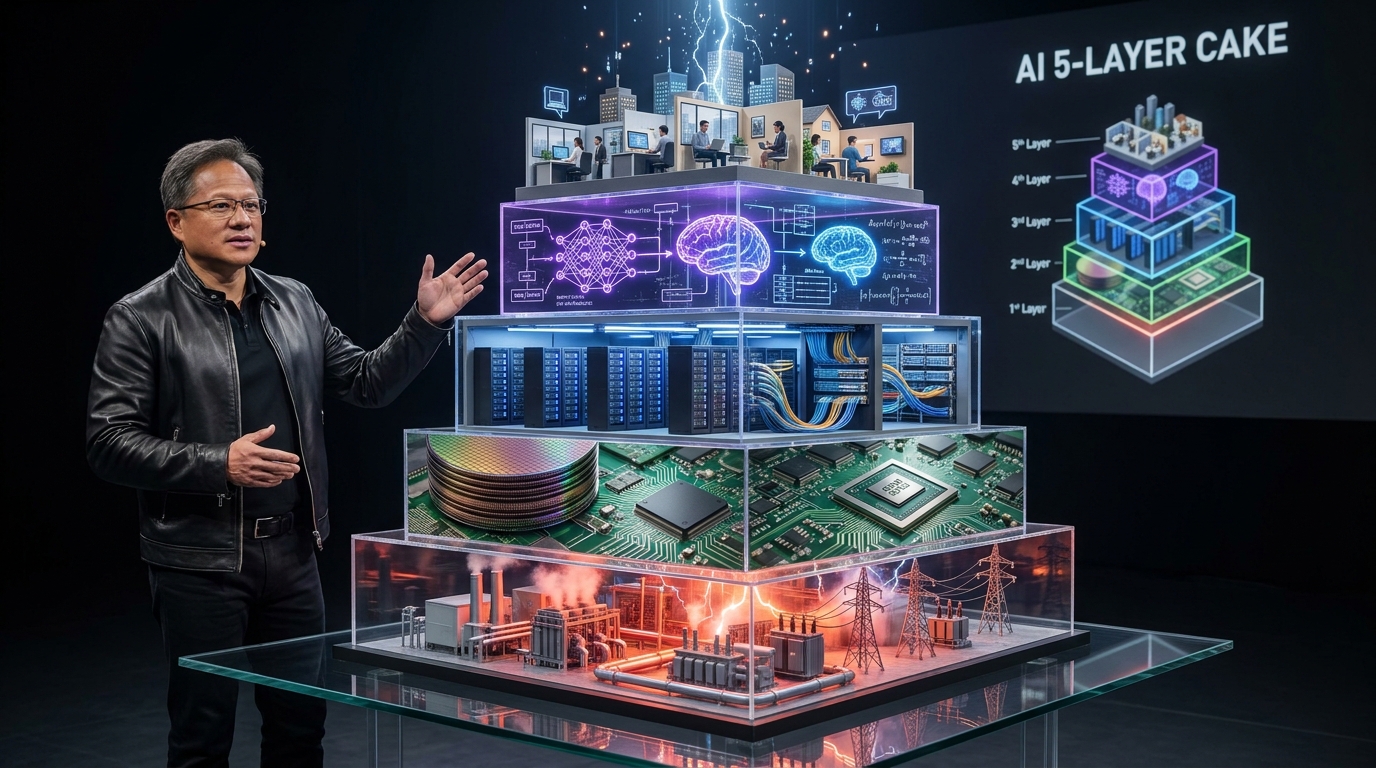
NVIDIA CEO Jensen Huang has defined the current AI industrial ecosystem through a highly intuitive and structural model known as the “5-Layer Cake.” As Jensen Huang emphasizes:
“AI is not just smart software or a collection of fancy apps. It is a massive physical infrastructure—much like electricity, roads, or railroads—that will serve as the foundation for our economy and society moving forward.”
For those seeking to grasp the macro trends of our world, this framework is more than just a timeline of technological advancement. It serves as a comprehensive textbook of economics and engineering, vividly illustrating where capital is flowing like a waterfall and how global industrial power is being restructured.
A Shift from “Light” to “Heavy” Revolutions
In the early 2000s (the Internet revolution) and the 2010s (the mobile revolution), we experienced “light” revolutions centered on invisible software and code. During those times, the belief prevailed that a great idea and solid coding skills were enough to change the world.
However, the AI revolution currently unfolding is fundamentally different. It is a process of “physical infrastructure reconstruction” on a scale never seen before in human history. Over the next five years, an estimated $7.6 trillion (approximately 10 quadrillion KRW) will be poured into steel, concrete, copper wires, and massive power grids.
This is the birth of the “AI Factory”—a colossal manufacturing plant designed to churn out tangible “intelligence” from intangible “data.” Let’s perform a deep dive into this miraculous process, dissecting the five layers from the foundational base to the top-tier user services
Layer 1 : Energy — The Massive Physical Limit and the ‘Power War’ Sustaining Digital Magic
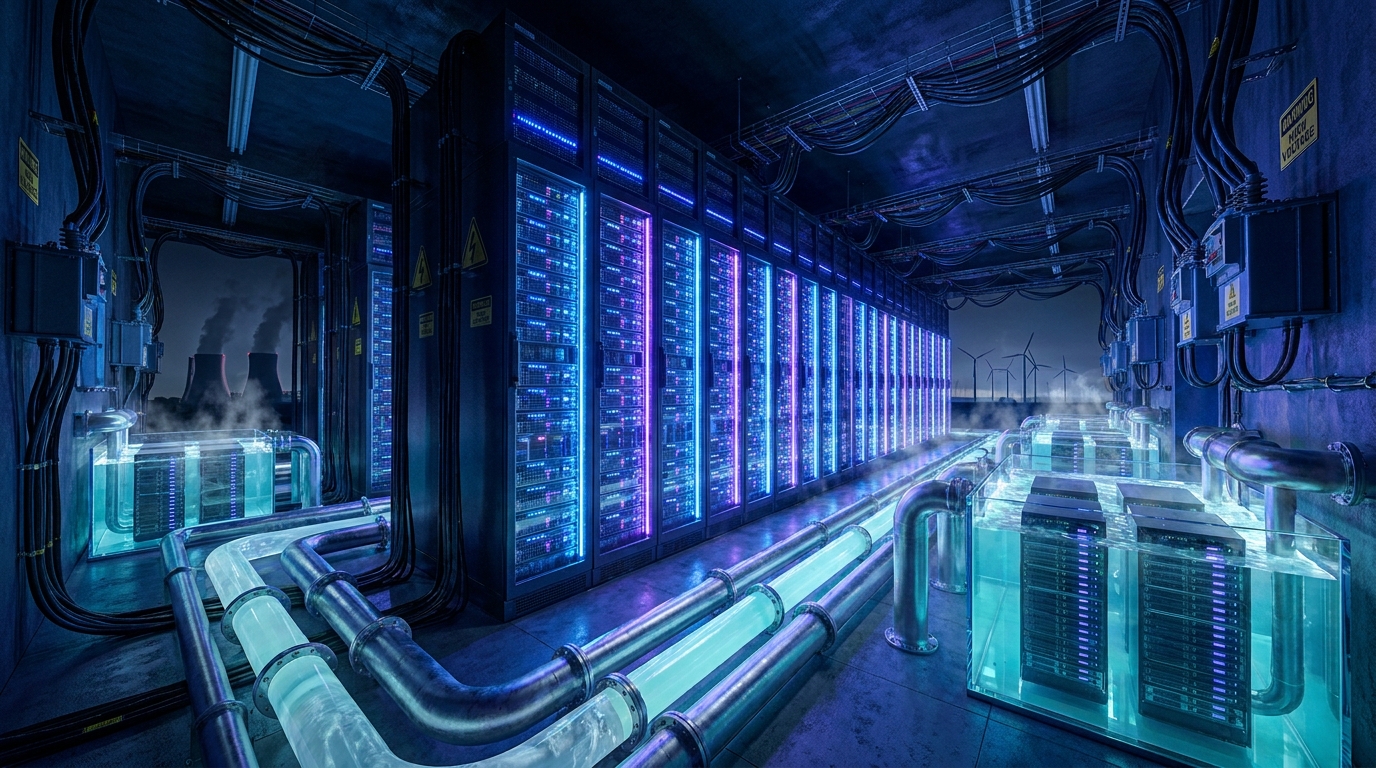
1. The Essence of AI : ‘Thermodynamics,’ Not Just Software
People often perceive Artificial Intelligence as ethereal software floating in the “cloud.” However, as NVIDIA CEO Jensen Huang famously declared, “Without energy, there is no intelligence.” The reality of AI is profoundly physical.
At the very moment you prompt ChatGPT, Gemini, or Claude, billions of electrons are surging through cutting-edge semiconductor chips in data centers thousands of miles away, generating blistering heat. In essence, AI is a classical thermodynamic machine: it consumes massive amounts of electrical energy, converts it into computational power, and must manage the resulting waste heat.
2. An Ecosystem Stalled by Power, Not Chips
The most critical threat currently strangling the global AI industry isn’t a shortage of high-end chips; it is the depletion of available power. Experts project that by 2026, global data centers will consume approximately 1,050 Terawatt-hours (TWh) of electricity. If data centers were a single nation, they would rank as the 5th largest energy consumer in the world, positioned right between Japan and Russia.
3. The Velocity Mismatch : Physical Grids vs. AI Speed
The root cause of this crisis lies in a fundamental “velocity mismatch” in supply cycles. Expanding a server line with the latest AI hardware typically takes 1 to 2 years. Conversely, building a new power plant, installing high-voltage transformers, and upgrading a national power grid is a grueling infrastructure process that takes anywhere from 5 to 10+ years. This creates a massive bottleneck, where digital acceleration slams into the hard physical limits of the power grid.
4. Big Tech’s Counterattack : Becoming ‘Energy Corporations’
Faced with this existential crisis, hyperscalers like Google, Microsoft, and Amazon are completely flipping the script. Instead of passively waiting for utility companies to provide electricity, they are evolving into “Energy Developers.” They are pouring astronomical capital into Small Modular Reactor (SMR) technology and securing decades-long exclusive power purchase agreements (PPAs) for solar and geothermal energy.
5. The Key to Breaking Limits : ‘Liquid Cooling’
Beyond securing power, the most urgent task is the “war against heat.” As computational density explodes, traditional air-cooling methods—essentially massive air conditioning—have reached their limits. The industry is now pivoting toward ‘Liquid Cooling’ as an indispensable survival infrastructure. This involves either immersion cooling (submerging servers in specialized cooling fluids) or direct-to-chip cooling (running chilled water pipes directly over the processors).
Layer 1, the very foundation of the AI cake, is the ultimate physical battlefield. It is a trial of how efficiently humanity can harvest the Earth’s energy and master thermal control to manifest the miracle of invisible intelligence.
Layer 2 : Chips and Memory — The Limitless ‘Acceleration Engine’ and the ‘Superhighway’ Through the Bottleneck
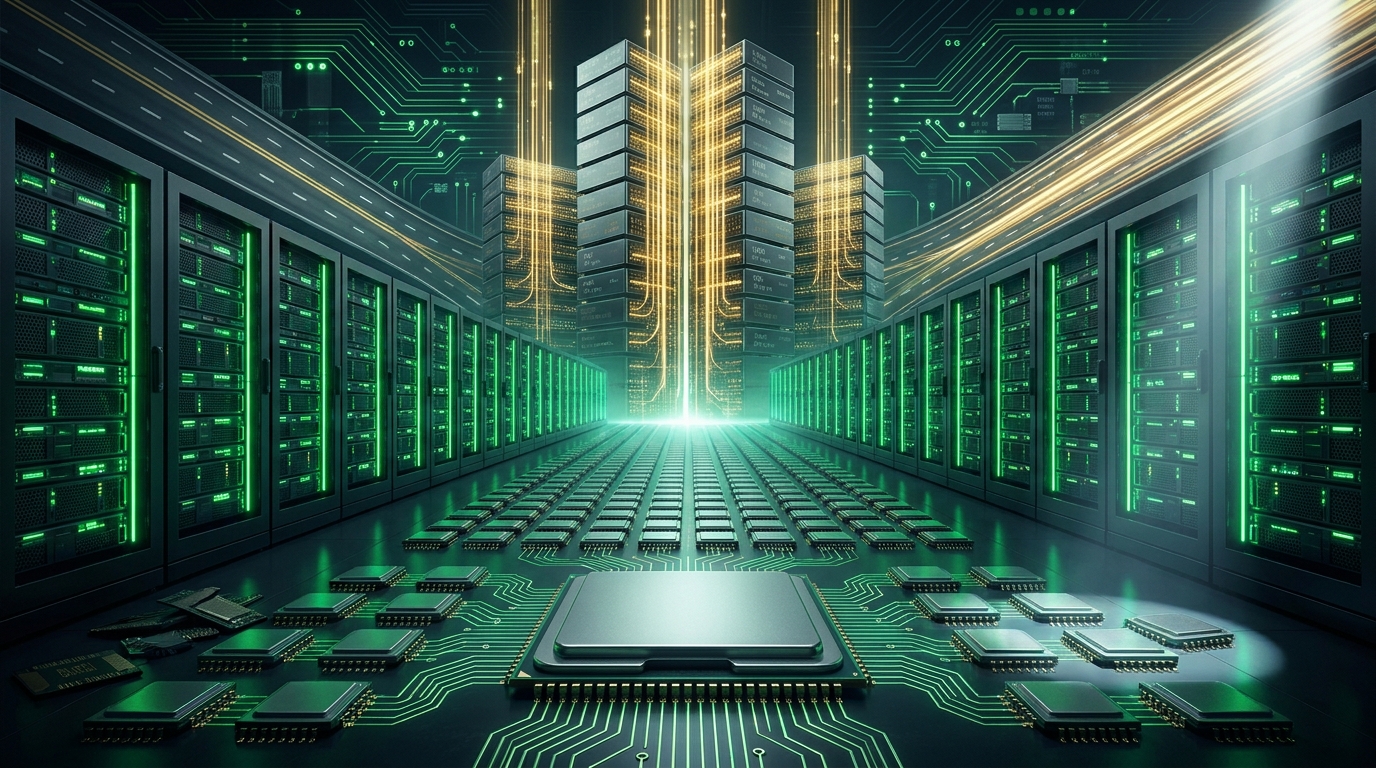
1. Paradigm Shift: From a University Professor (CPU) to Tens of Thousands of Elementary Students (GPU)
Once energy is supplied to the massive factory known as the data center, a core “brain” is needed to process this raw energy into high-dimensional “intelligence.” This is where the AI Accelerator (GPU), epitomized by NVIDIA, enters the stage.
Think of the Central Processing Unit (CPU), once the heart of computing, as a “brilliant university professor” who solves complex mathematical problems alone and in sequence. In contrast, a GPU is like a “mob of tens of thousands of elementary students” who handle simple arithmetic all at the same time. AI’s deep learning requires smashing and reassembling gargantuan amounts of text fragments and pixels simultaneously. In this realm of massive, simple labor, the ‘Parallel Processing’ power of the student army far outshines the serial logic of the professor, ultimately triggering the AI revolution.
2. Racing Engine, Blocked Road: The ‘Memory Bottleneck’ Dilemma
However, a fatal bottleneck soon emerged in this massive computational factory. While the speed of the GPU “engine” was skyrocketing day by day, the speed of the “Memory Semiconductor”—the warehouse that feeds data to the engine and stores the results—could not keep up. No matter how fast the tens of thousands of students solve their problems, if the “tollgate” for moving worksheets and answer keys is too narrow, the children end up sitting idle.
3. From an 8-Lane Road to a 1,024-Lane Autobahn: The Arrival of ‘HBM’
The hero that cleared this suffocating traffic jam is High Bandwidth Memory (HBM). Breaking the traditional DRAM paradigm of wide, single-story buildings, HBM stacks semiconductors vertically like a high-rise apartment. It then drills tens of thousands of microscopic holes (TSV, Through-Silicon Via) between the floors to drop data vertically. Thanks to this revolutionary “architectural” method, the 8-lane road for data has been expanded into a 1,024-lane super-Autobahn.
4. Korea’s Grip on the AI ‘Choke Point’: The HBM Oligopoly
Currently, the hegemony of the global HBM supply chain is held by just three companies: South Korea’s SK Hynix and Samsung Electronics, and America’s Micron. As the volume of data absorbed by models like ChatGPT expands exponentially, demand for HBM has exploded. However, the manufacturing process of perfectly connecting these “apartments” with microscopic holes is so difficult that the Yield (the ratio of non-defective products) barrier is extremely high. As a result, the global HBM supply for 2026 is already sold out to Big Tech giants, meaning Korean companies essentially hold the “choke point” in the AI speed race.
5. Unstoppable Capital Rush: The Economics of ‘Harsh Service Life’
Another economic truth we must understand at this layer is the radical shortening of the ‘economic service life’ of hardware. Just a few years ago, a standard server chip was an asset that could be used for a solid 4 to 6 years. Today, new AI accelerators with 2 to 3 times the performance are released every single year.
Older chips simply cannot handle the massive time and electricity costs required to train the newest models. Consequently, global Big Tech firms are forced to discard expensive, perfectly functional chips and pour trillions of dollars into purchasing new ones every year—running on a “perpetual treadmill.” Because the rate of technical obsolescence is faster than in any other industry, this second layer has become a brutal capital battlefield where stopping for even a moment means permanent elimination.
Layer 3 : Infrastructure — Clouds Descending to Earth, the ‘Concrete Cloud’ and the Neural Network War
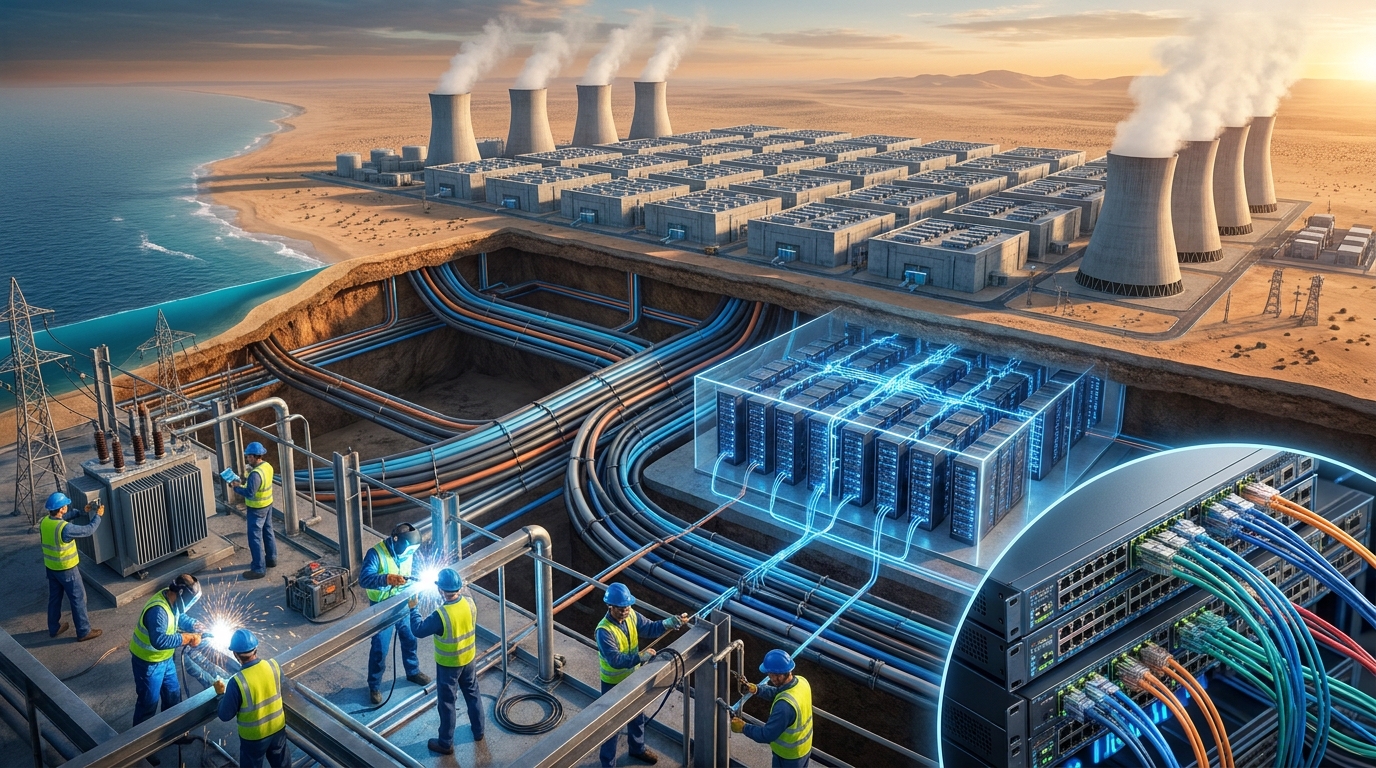
1. The Shattering of an Illusion: Cloud is ‘Rebar and Concrete,’ Not Vapor
We often hear the word “Cloud” and imagine a light, transparent, and magical data space floating in the sky. However, the Cloud of the AI era, as defined by Jensen Huang, is a thoroughly heavy and physical entity.
The real face of the Cloud is a massive concrete fortress the size of dozens of football fields, standing in the middle of a vast desert. It is a tangle of massive cooling towers spitting steam into the sky and “veins” of thick fiber-optic cables, millions of kilometers long, stitching continents together beneath the ocean floor. This is no mere data warehouse; it is the raw reality of the ‘AI Factory’—a modern-day mega-plant that takes raw ‘data’ as fuel to churn out the high-value commodity known as ‘Intelligence.’
2. The Paradox of High Tech: The ‘Blue-Collar’ Renaissance
An incredibly interesting and paradoxical economic phenomenon occurs during the construction of these high-tech factories. To build the hardware that runs invisible software, a massive amount of the world’s most traditional, sweat-soaked physical labor is required.
To erect tens of thousands of tons of steel beams, move transformers the size of trucks, and meticulously connect high-voltage power cables as thick as a human arm, the market value of skilled plumbers, high-voltage electricians, and welders is skyrocketing globally. Behind the chilling fear that AI will steal white-collar jobs lies an unprecedented Golden Age for blue-collar workers who are building this ‘Concrete Cloud’ with their own hands.
3. The Magic of Stitching 100,000 Brains: ‘Ultra-Low Latency Networking’
Step inside this heavy infrastructure layer, and you’ll find the most suffocating and sophisticated battlefield of engineering: Networking, the art of connecting chip to chip.
To train the latest mega-AI models, one or two GPUs won’t cut it. You must tie together over 100,000 top-tier GPUs with millions of strands of fiber-optic cable to make them act as a single, massive ‘Unified Brain.’ For 100,000 brains to exchange vast fragments of knowledge and sing in unison, even a 0.000001-second lag (latency) or a 1-byte “out-of-tune” note (data loss) is unacceptable. This is a high-stakes realm where a single cable can determine the life or death of the entire system.
4. Empire’s Monopoly vs. Alliance’s Openness: InfiniBand vs. Ethernet
A global “World War” is currently raging between two giant camps over this nerve-wracking network market.
On one side is the ‘InfiniBand’ camp, pushed by NVIDIA, which currently dominates the GPU market. Like Apple’s iOS, it is a strictly closed ecosystem, but it rules the market with the weapons of ultimate stability and speed optimized for its own chips.
On the other side is the ‘Ultra Ethernet’ alliance, where Broadcom, Google, and Meta have joined forces to break this “dictatorship.” They are fighting back by opening up Ethernet technology—the universal standard of the internet—much like Android, making it high-performance yet accessible and affordable for anyone to build infrastructure.
Ultimately, this third layer is not just a warehouse for stacking servers. It is the most dynamic hardware battlefield where the capital and technology of Silicon Valley giants collide at the level of physical cables to decide who will pave the fastest information highway to govern 100,000 chips.
Layer 4: Models — From Parrots to Reasoning Brains, and the ‘Merciless Wall of Money’
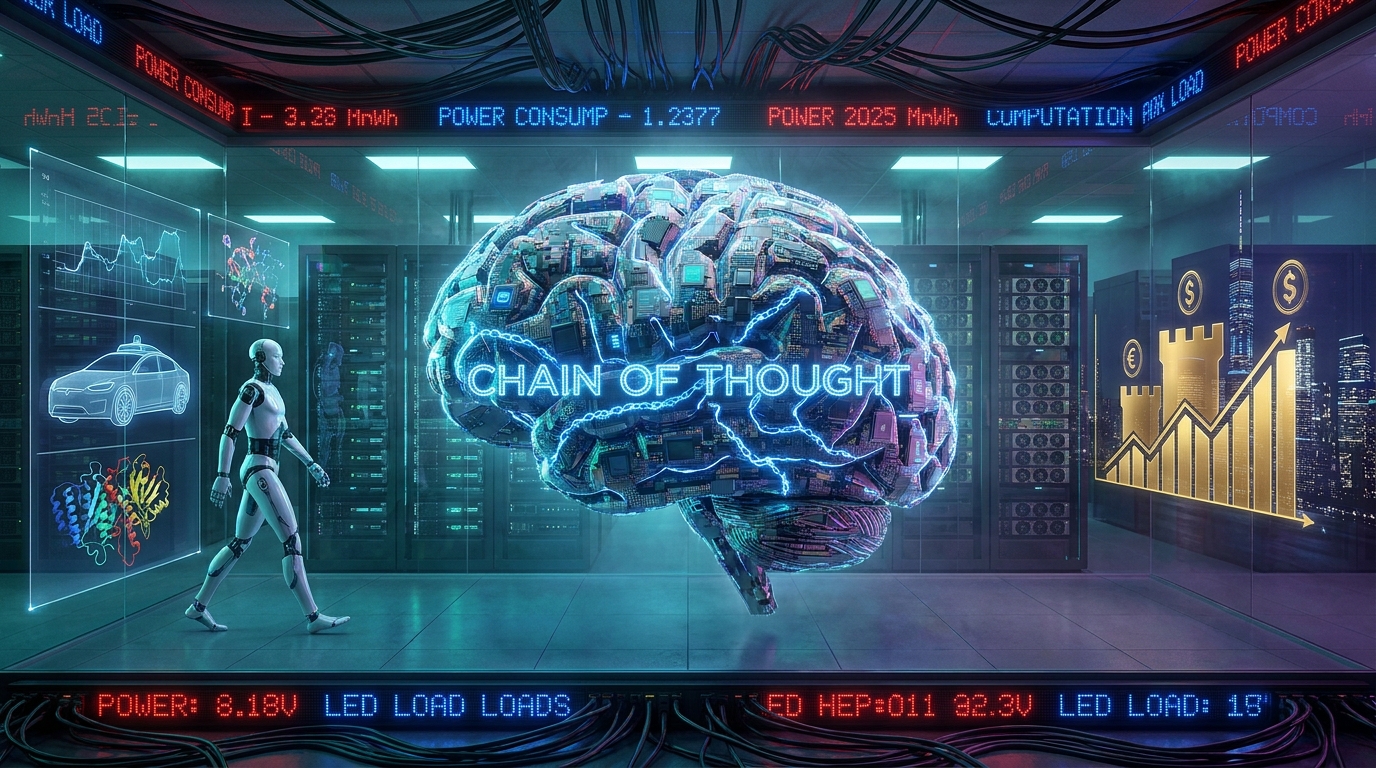
1. The ‘Soul of the Software’ Awakened Atop a Massive Physical Body
Once the grueling infrastructure work of Layers 1 through 3—the tangled web of rebar, power grids, and tens of thousands of semiconductor chips—is complete, it is finally time to breathe life into this massive physical frame. This is where the ‘Foundation Model,’ serving as both the heart and brain of artificial intelligence, takes its place at the fourth layer. The protagonists of this layer are the names we encounter daily in the news: OpenAI’s GPT series, Google’s Gemini, Anthropic’s Claude, and Meta’s Llama.
2. Evolution of the Statistical Parrot: From Memorization to ‘Reasoning Intelligence’
Only a few years ago, early Large Language Models (LLMs) were merely “statistical parrots”—highly sophisticated ones, but parrots nonetheless—that memorized vast troves of internet documents to “predict the most statistically probable next word.” However, as of 2026, the qualitative nature of these “souls” has leaped into an entirely different dimension.
AI no longer simply regurgitates memorized knowledge. When faced with complex mathematical riddles or intricate programming code, it no longer blurts out an answer. Instead, it designs a multi-step logical ‘Chain of Thought.’ It has entered the realm of ‘Reasoning,’ where it verifies its own hypotheses, self-corrects errors, and carefully derives a conclusion. As AI begins to truly “think,” enormous amounts of computational power and electricity are being consumed not only during the “Training” phase but also in the split second of “Inference” when the AI contemplates its response.
3. Intelligence Escaping the Screen: Exploring Physics and the Secrets of Life
Even more marvelous is how these models are breaking out of the world of on-screen text and expanding into the physical reality. AI has now evolved into ‘Physical AI,’ acting as the brain for bipedal humanoid robots and autonomous vehicles by perfectly understanding and simulating natural laws such as wind resistance, friction, and gravity. Furthermore, it is expanding its intellectual territory into ‘Biological AI,’ decoding the combination formulas of billions of amino acids to create miraculous protein structures that could cure cancer or previously terminal diseases.
4. The End of Romance: A ‘Winner-Take-All Fortress’ Only for Mega-Capital
Behind this grand evolution of intelligence, however, lies the cold shadow of ruthless capitalism. From the perspective of investment economics, the only law governing the fourth layer is a merciless ‘Economies of Scale.’
Training a single, human-surpassing ‘Frontier-class’ model now evaporates hundreds of millions—or even billions—of dollars in electricity bills and chip rental fees. The romantic era, where a college student with a genius idea or a passionate startup could change the world from a garage, is over. Only a tiny handful of American Big Tech giants, capable of firing off tens of billions of dollars in cash like ammunition, can clear this barrier to entry. This ‘Winner-Take-All Fortress,’ which monopolizes intellectual power within a massive wall of money, is the true face of the fourth layer.
Layer 5: Applications — The Pinnacle of the Cake, the ‘Final Judgment’ Where Only Revenue Secures Survival
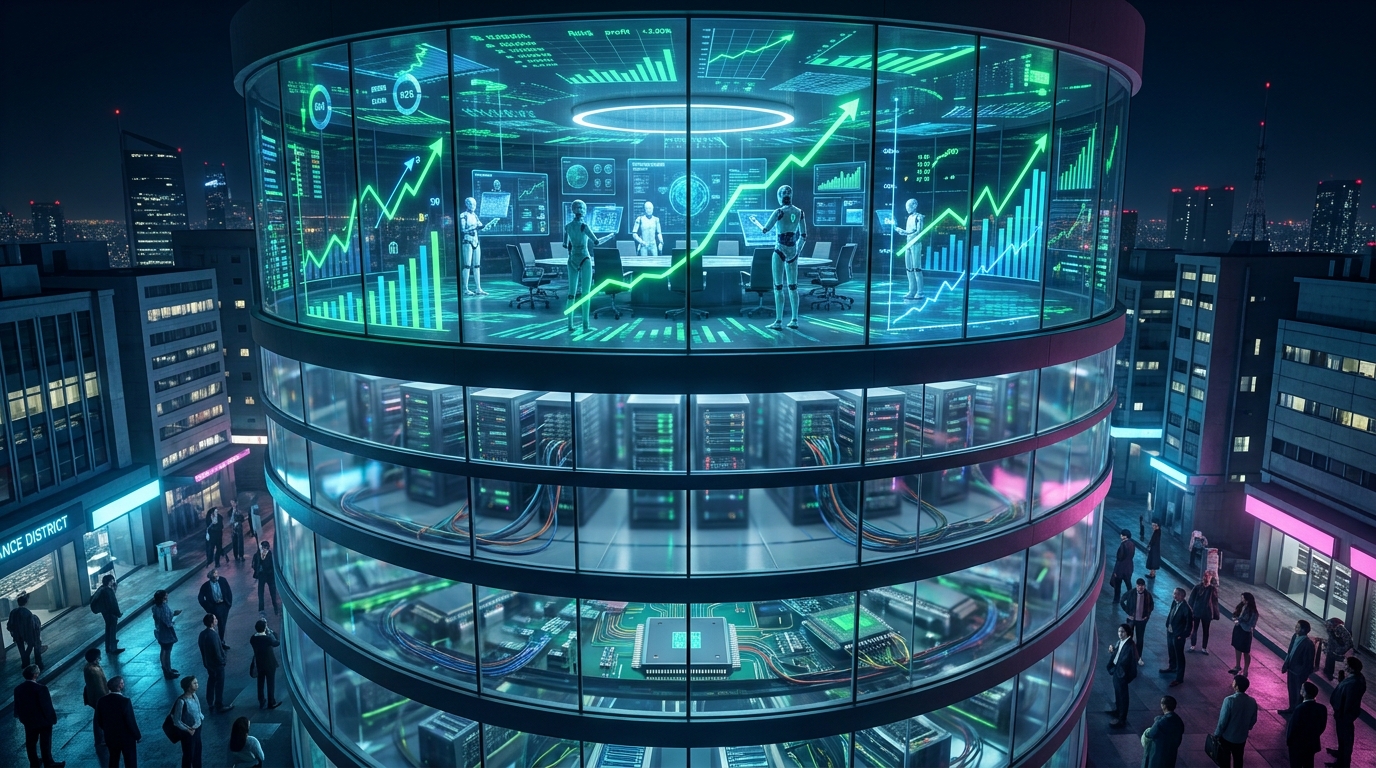
1. The Only Gateway to Repay Massive Debt
We have finally reached the summit of the cake—the fifth layer, where AI finally reveals its true form to individual consumers and enterprises. This layer is far more than a mere “service area.” It is the very spot about which Jensen Huang and global economists have issued their most urgent warnings.
To secure astronomical amounts of power, purchase expensive semiconductors, and build colossal concrete data centers (Layers 1 through 4), Big Tech giants have taken on trillions of dollars in debt. The only way to justify this unprecedented capital explosion is to open the wallets of companies and consumers right here in Layer 5, generating cold, hard cash (revenue and profit). If this layer fails to create substantial economic value, the brilliant engineering miracles built beneath it will collapse like a sandcastle. Layer 5 is the “Final Judgment” upon which the survival of the entire AI ecosystem depends.
2. The Era of Tools Fades, Autonomous ‘Agents’ Awaken
To survive this judgment, AI at this pinnacle has undergone the most explosive paradigm shift in recent history: the evolution from a passive “Tool” to an autonomous “Agent” that fully replaces human tasks.
Until recently, AI was little more than a glorified word processor or a fancy version of Excel. It only moved when a person gave it specific, step-by-step instructions like “Summarize this text” or “Fix this code.” But the newly arrived Autonomous Agent is different. Now, a user simply provides a high-level, macro “Goal,” such as: “Analyze our competitors’ marketing trends over the past year and complete a strategic proposal for our new product launch in PPT format.”
The Agent then plans its own path. It dispatches web-scraping AI to gather global news, utilizes data-analysis AI to extract financial figures, composes a logical report via a language model, and finally calls upon design AI to create a polished set of PPT slides. This marks the birth of the “Digital Employee”—an entity that coordinates dozens of independent AIs like a commander to complete a mission on its own.
3. Real Numbers Shatter Illusions: The Era of Proving ROI
The market is no longer interested in philosophical questions like “Can AI resemble humans?” Instead, it demands the cold reality of a balance sheet: “How much does this AI reduce costs, and by how much does it increase profit?”
Specialized agents are finally proving their worth through these numbers. Agents deployed on manufacturing production lines have slashed defect rates by over 50% by sensing microscopic vibrations in machinery. Legal agents hired by law firms sift through tens of thousands of precedents in minutes to craft winning litigation strategies, while coding agents in software firms have boosted developer productivity by over 30% overnight.
The era of making money on vague, hollow expectations of the future is over. In an extremely cold and calculating business environment, the only winners at the top of this 5-layer cake will be the applications that save human time, drastically cut costs, and deliver undeniable ROI (Return on Investment).
Macroeconomic and Geopolitical Implications: The Context of Future Capital for Novice Investors
Beyond simply understanding the five-layer structure, you must be able to read the three major structural shifts currently occurring in the global capitalist market through this “5-Layer Cake” framework.
1. Avoidance of the “Middle Kill Zone” and Polarized Investment Strategies
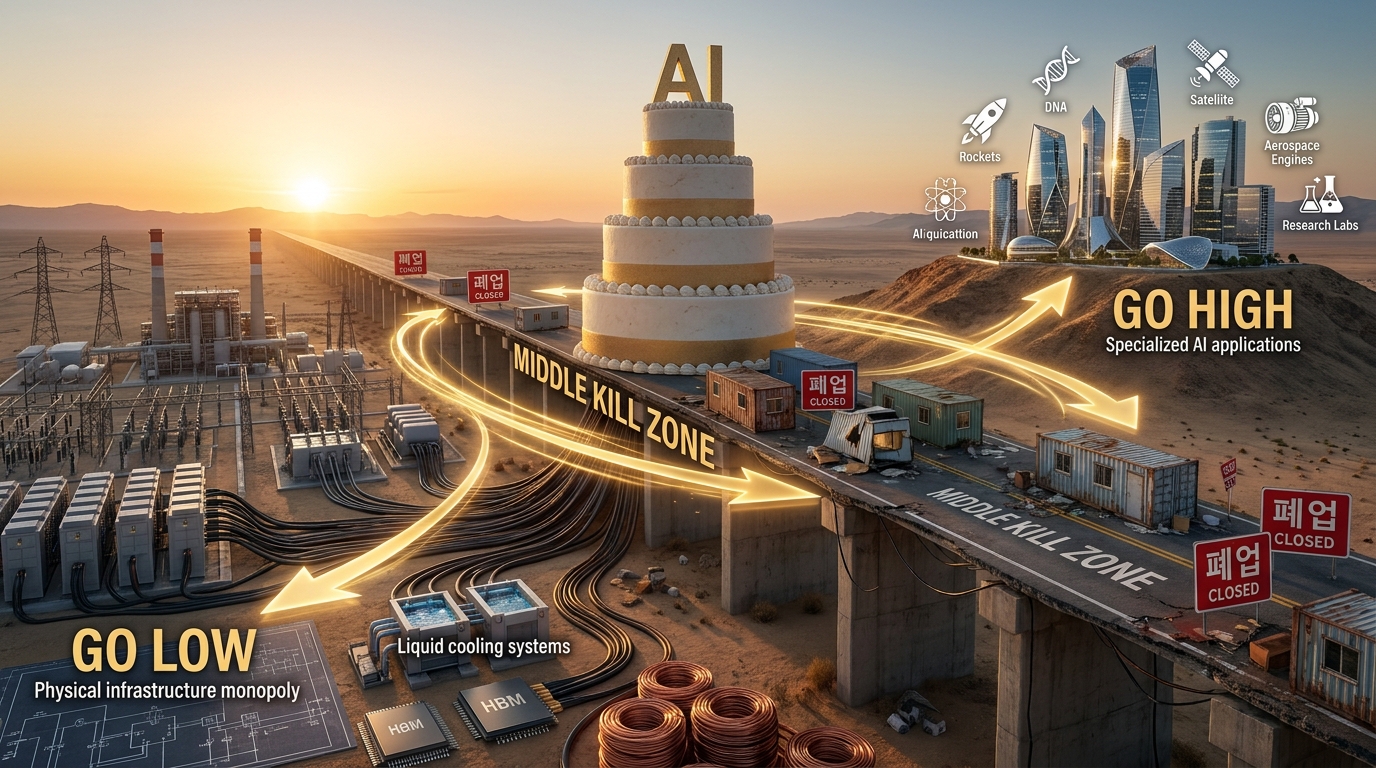
From a business strategy perspective, mid-tier software startups—those that provide mediocre services by merely wrapping thin layers over massive platforms—are exposed to the so-called “Middle Kill Zone.” These companies face instant bankruptcy the moment giants like Google or OpenAI update their core features for free.
Consequently, global “smart money” (investment capital) is adopting an extreme polarization strategy:
- “Go Low” Strategy: Betting on the monopolization of foundational physical assets at the bottom that are impossible to replicate, such as power grids, specialized cooling systems, and HBM memory.
- “Go High” Strategy: Pouring capital into specialized AI services at the top layer that generate irreplaceable high value by integrating expert domain knowledge, such as drug discovery or precision aerospace engineering.
2. The Emergence of “Sovereign AI”: A New Geopolitical Race
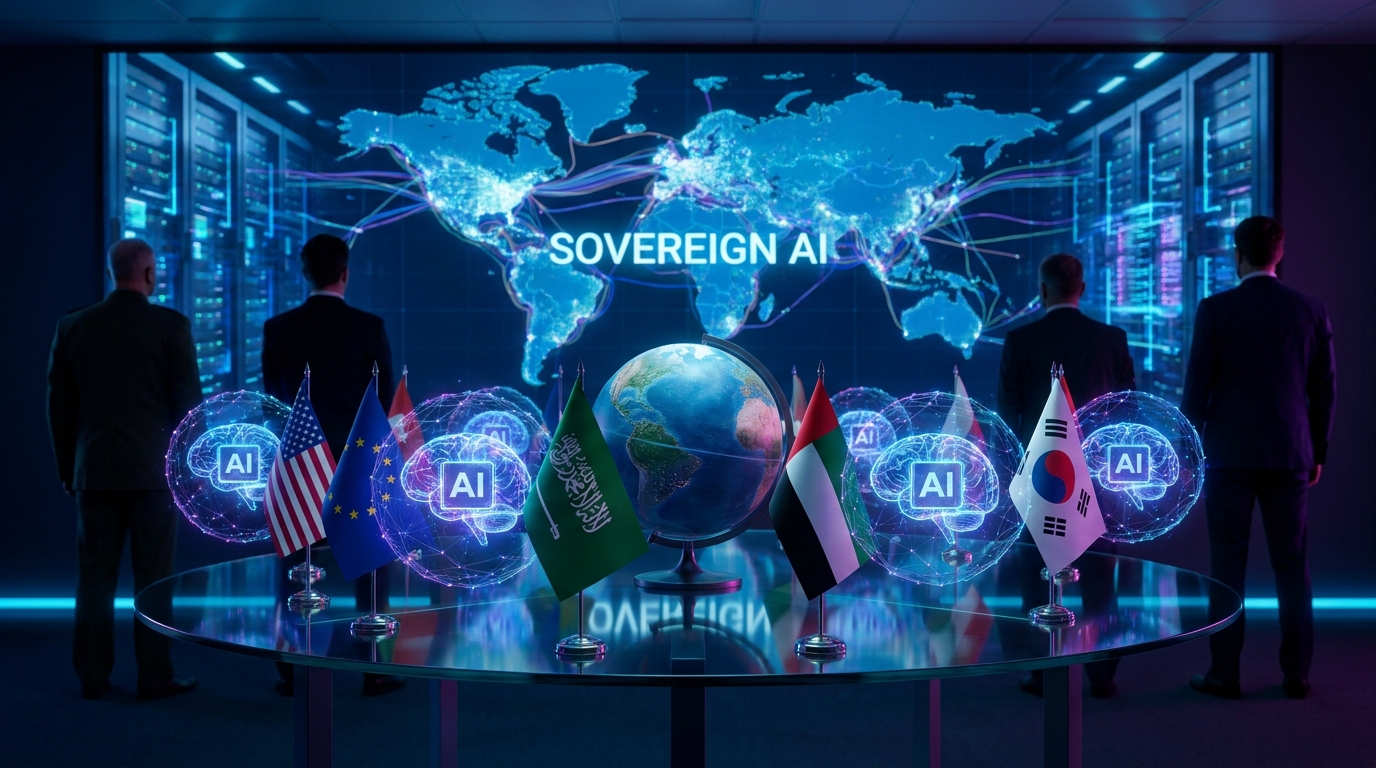
As AI is elevated to a core infrastructure for military security and the economy, a new sense of crisis is brewing. There is a fear that if a few Silicon Valley Big Tech firms are allowed to monopolize global data and intelligence networks, dependent nations will degenerate into “digital colonies.”
Accordingly, major nations—such as Saudi Arabia and the UAE in the Middle East, the European Union with its strict regulations, and South Korea, which seeks to protect its independent platform ecosystem—are investing astronomical tax revenues to build:
- Independent AI Models that accurately understand their unique languages, cultures, and historical values.
- Massive Domestic Data Centers to run these models securely.
The expansion of intelligence infrastructure has transformed into a modern version of the geopolitical hegemony race that once focused on building military strength and expanding territory.
3. The Achilles’ Heel: Big Tech’s CAPEX and the Debt Dilemma
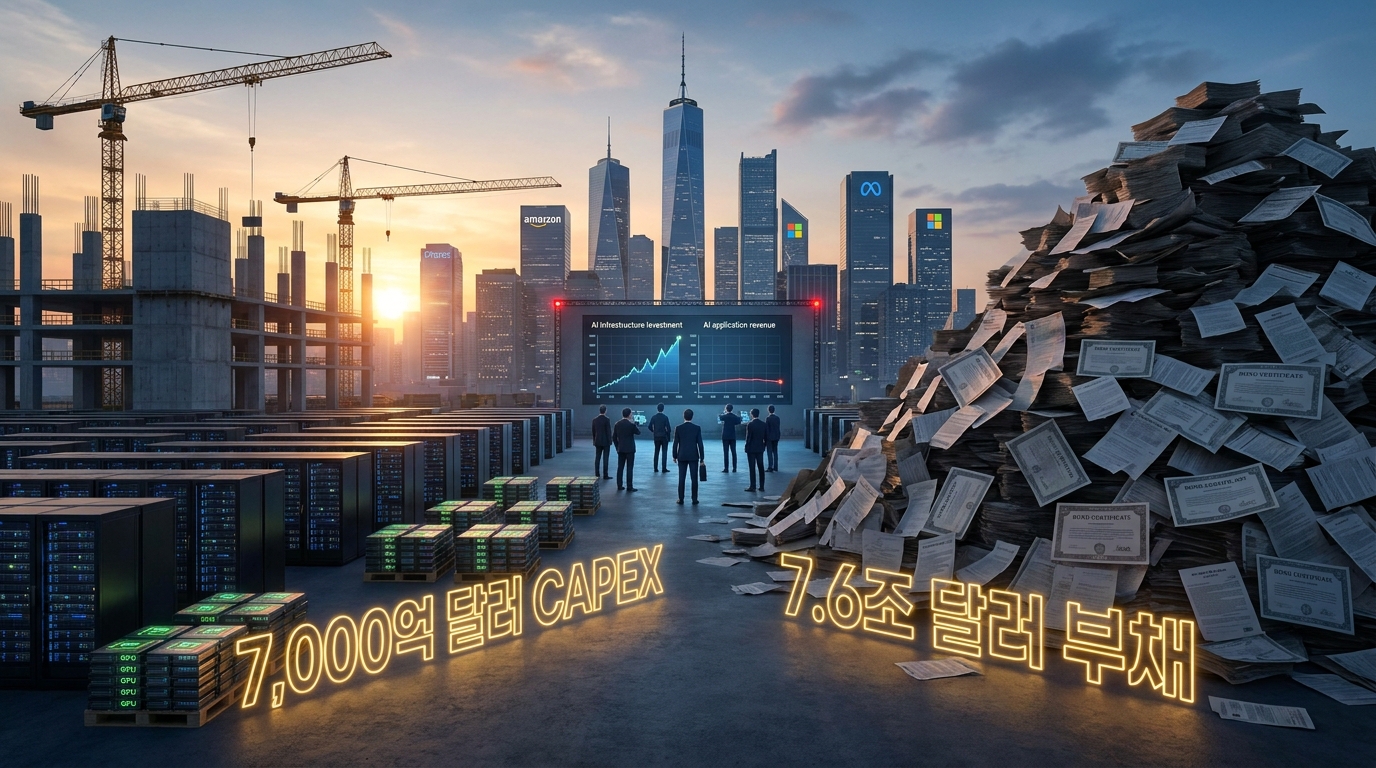
Currently, tech giants (hyperscalers) are expected to pour more than $700 billion (approx. 950 trillion KRW) into new chip purchases and data center construction in 2026 alone to gain the upper hand in the AI hegemony race. During the past internet boom, investments were covered by the net cash flow generated by companies; however, the current scale of investment exceeds corporate “basic fitness,” leading to a precarious situation where they are issuing massive amounts of corporate bonds (debt) to build infrastructure.
Wall Street economists fear a specific scenario: after spending astronomical sums to perfectly build Layers 1 through 4, what happens if the monetization of Layer 5 (the AI application market) is delayed because businesses or consumers refuse to pay expensive monthly subscription fees?
The mountain of $7.6 trillion in debt could collapse like a sandcastle if investment returns are not realized, leading to a massive macroeconomic shock comparable to the dot-com bubble burst of 2000. Therefore, when reading economic news, you should keep a hawk’s eye on whether a company is actually generating enough cloud and AI software revenue to offset its massive infrastructure investment costs, rather than focusing solely on chip performance competition.
Conclusion: The Era of Industrialized Intelligence—How Should We Prepare?
This era is not merely about computer programs becoming slightly smarter. Just as humanity mastered electricity to achieve the industrial revolution of mass production, we are now entering an age of “Industrialized Intelligence.” In this new era, the intangible asset of “Intelligence” is mass-produced in factories via power grids and semiconductors and supplied through global pipelines.
NVIDIA’s 5-layer cake framework serves as a perfect master plan. It illustrates how invisible, cutting-edge digital innovation codes mesh like gears with the roughest physical realities—concrete, copper cables, water, and power grids—to fundamentally reshape the global industrial economy.
In the midst of the interactions across these five massive layers, your most powerful weapon will be cultivating a “structural mindset.” This means tracking where the $7.6 trillion capital cycle is heading and identifying the resulting bottlenecks and emerging demands. Such a mindset will allow you to ride the massive waves of the future economy and seize opportunities rather than being swept away by them.
이 콘텐츠의 이미지는 AI 모델의 지원을 받아 생성되었습니다.