If AI computation becomes 100 times faster… Should I sell NVIDIA stock? Can my portfolio continue to generate returns?


Our NVIDIA stock is hitting new highs every day, and assets invested in Samsung Electronics and SK Hynix are bringing in pleasant returns. We are currently savoring the sweet fruits of the AI revolution. However, beneath the seemingly endlessly robust dominance of giant IT companies, a massive wave of change that we haven’t yet noticed is silently approaching.
The core of this change is ‘AI computation lightweighting’ (making AI technology lighter and faster). I am writing this article with the thought that if we fail to properly read this wave, we might end up becoming investors who pay the highest price for ‘technology of a bygone era’.
1-Minute Summary
- The Great Migration of Intelligence: The power of AI is shifting from large data centers (brains) to devices near us (neural networks).
- Physical Limitations: Power shortages, astronomical costs, and latency issues are putting a brake on the current ‘large AI’ approach.
- New Opportunities: Beyond hardware, will companies that preemptively secure software platforms and ‘my own assistant (AI agent)’ become the next protagonists?
1. The Giant Brain and the Body’s Neural Network: Cloud and Edge
To properly understand the flow of AI investment, we must first grasp the ‘survival principles’ of AI. It’s very easy to understand if we compare it to our bodies.
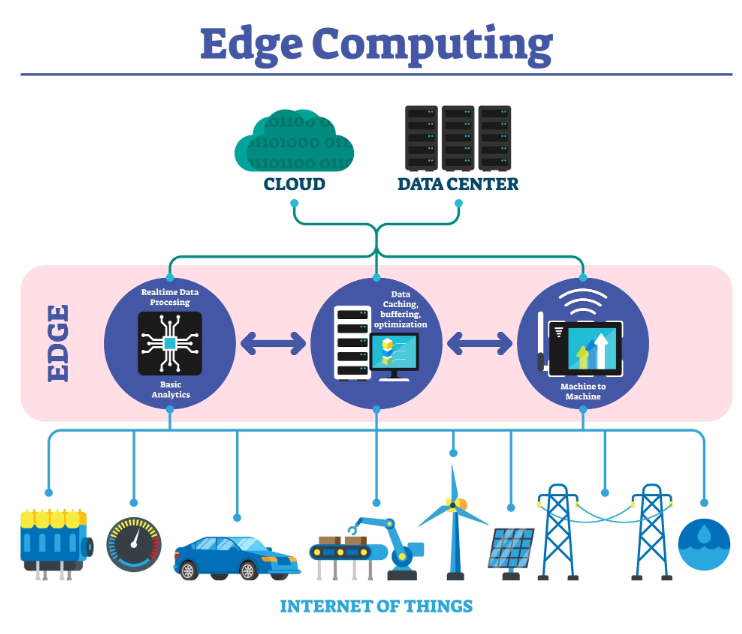
Centralized Intelligence (Cloud AI): The Giant Brain
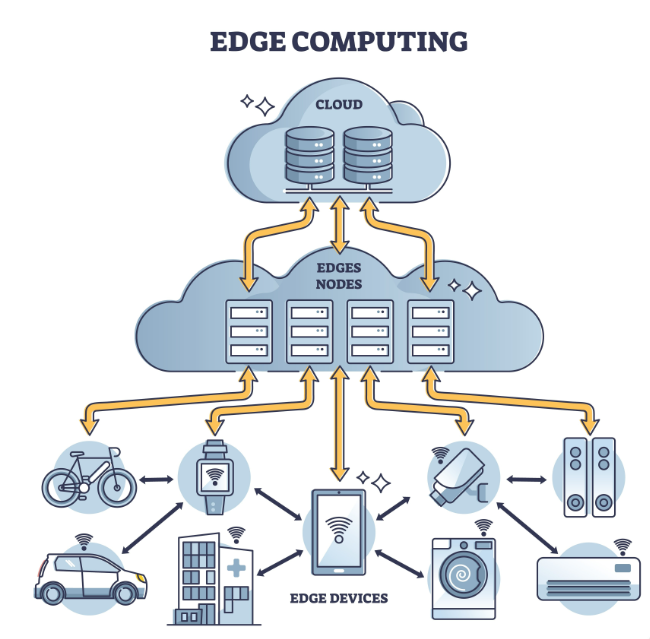
First, there is a ‘giant brain’ at the center of our body that handles all complex thinking, learning, and reasoning. The large data centers of Amazon (AWS), Microsoft (Azure), and Google (GCP) that we commonly hear about today play this role. Here, tens of thousands of NVIDIA semiconductors consume enormous amounts of electricity, learning data 24/7, and creating the smart AI (large language models) that amaze us. Until now, 99% of AI investment has been focused on making this ‘central brain’ bigger and more powerful.
On-site Responsive Intelligence (Edge AI): Neural Networks Spread Throughout the Body
However, our body has another system: the ‘neural network.’ For example, imagine accidentally touching a hot pot. Our body doesn’t wait for the signal to reach the brain and for a command like ‘It’s hot, take your hand off’ to be issued. The nerve cells in the spinal cord react immediately, causing us to withdraw our hand.
This is the essence of ‘Edge AI.’ It’s a system that makes immediate judgments and reactions right where the data originates – in the smartphone in our hand, the car we drive, or the sensors in a factory.
2. The Conventional Wisdom of AI Investment We’ve Believed In, and the Changes Beneath the Surface
Until now, when we thought of AI, we first imagined massive data centers and tens of thousands of semiconductor chips. However, even this seemingly perfect growth formula is slowly showing signs of change.
The Market’s Conventional Wisdom We Believe In: “The Bigger, The Safer”
The market logic that our investors currently trust most is very clear: the future of Artificial Intelligence (AI) ultimately depends on ‘how much larger and more powerful computing facilities one possesses.’
To create and train smart services like the well-known ChatGPT, a massive infrastructure involving tens of thousands of expensive semiconductor chips, worth trillions of won, manufactured by NVIDIA, is essential. This is why Microsoft poured tens of trillions of won into OpenAI, a company whose name was unfamiliar, and why Amazon and Google continue to build data centers with astronomical sums of money. In the face of such immense financial power, most companies dare not even issue a challenge.
Our investors firmly believe in the ‘fortress of money and technology’ built by these giant corporations. They buy shares of big tech companies with the conviction that “with this scale, they will never fall,” considering this the safest ticket in the AI revolution. NVIDIA’s market value soaring to one of the highest in the world in the summer of 2024 is strong evidence of how robust this market belief is.
Practical Barriers: The Shadows Hidden Behind Dazzling Growth
The Unbearable Wall of ‘Electricity’
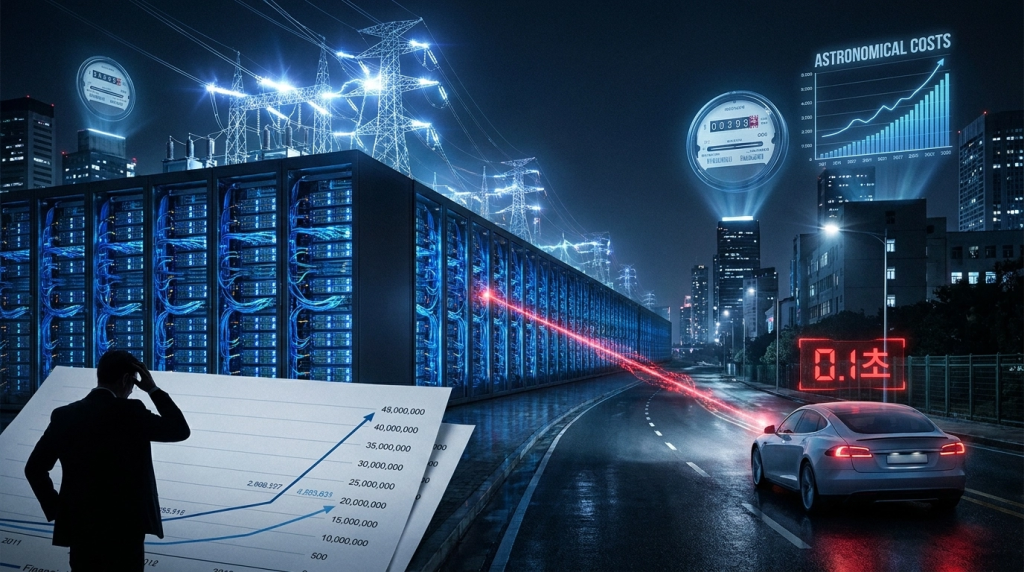
The first problem encountered is energy. According to the International Energy Agency (IEA), global data center electricity consumption is projected to exceed Japan’s total electricity consumption by around 2026. The AI craze is, in effect, testing the limits of our society’s power grid. This ultimately increases the cost of operating facilities exponentially, becoming a significant burden even for giant corporations.
Astronomical Costs Piling Up Like a Snowball
It costs too much money. It is said that maintaining the commonly used ChatGPT (GPT-4) for just one day costs nearly billions of won. This is merely the cost of ‘using’ an already created AI; ‘training’ a new AI requires funds exceeding hundreds of billions of won. Even for large corporations with abundant financial resources, there are clear limits to indefinitely nurturing a ‘money-eating hippopotamus’ where expenses outweigh profits.
The ‘0.1-Second Wall’ That Determines Life and Death
The most critical problem is the unseen distance information travels. For example, consider a self-driving car on the road encountering a sudden unexpected situation. The fleeting moment (latency) it takes to send this information to a distant large data center and receive a response back becomes a life-or-death crossroads, determining whether an accident is prevented or not. The same applies to robot arms in smart factories.
No matter how smart the central ‘giant brain’ is, if the physical distance from the on-site causes delayed responses, fundamental barriers will inevitably arise in applying it to real-life situations.
3. The Shift in the Power of Intelligence: From “Centralization” to “Self-Reliance”
In the past, to obtain any information or technology, one had to go through a ‘central’ point. However, as technology advances, that power gradually descends to our side (on-site). This is called the ‘shift in the power of intelligence,’ and it can be examined from three perspectives.
Shift in Decision-Making Power (Who Decides?)
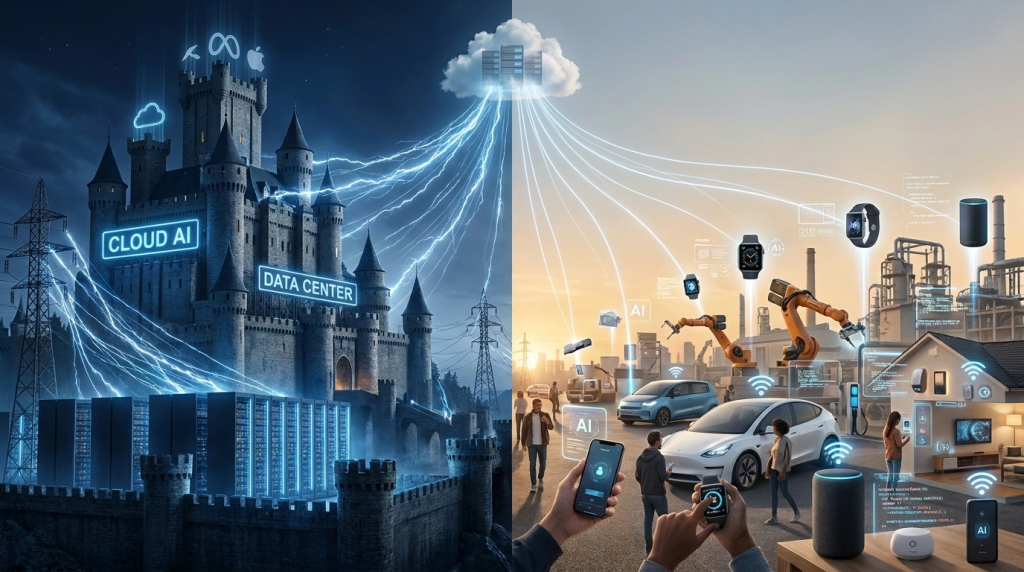
In the past, AI required very complex calculations, so it was necessary to query and receive answers from the supercomputers owned by giant American corporations (Google, Microsoft, etc.). In other words, the decision-making power resided in the ‘fortress (central server).’ However, as AI becomes lighter (lightweighting), smartphones or cars in our hands begin to make their own decisions without asking the central server. There is no longer a need to seek permission from a distant ‘smart brain.’ The initiative for decision-making is thus shifting from the center to the devices near us.
Shift in Wealth (Where Does Money Accumulate?)
Until now, most AI investment money has flowed to companies building ‘giant fortresses.’ Companies like NVIDIA, which produce semiconductors with immense computing power, or those with large-scale servers, were the main players. However, as intelligence spreads to devices around us, the flow of money now shifts to ‘how smartly those devices are made’ or ‘what convenient services are provided within those devices.’
- Past: “Who owns the biggest factory (data center)?”
- Future: “Who owns the smartest tools (software/devices) closest to our lives?”
Shift in Ecosystem (Who Dominates the Market?)
In the past, when you bought an electric car, the car company was in charge, but now the company that updates the autonomous driving software holds the real power. When AI becomes lightweight and directly integrated into our everyday devices, ‘those who manage and update the intelligence within the devices’ will dominate the market, rather than ‘those who sell hardware.’ This is a major shift where the monopolistic power of companies with large infrastructure weakens, and opportunities pass to companies with innovative software technology.
4. Thoughts on the Advent of a New Era: Intelligence Descending to Our Side
Won’t the ‘Weight of Data’ Determine the Shift?
We can call this the ‘gravity of data.’ Just as the Earth pulls objects, places where a lot of data accumulates naturally attract the computing power needed to process that data.
Sending the enormous amount of data pouring out from billions of smartphones and cars worldwide every day to distant cloud servers is becoming economically and physically almost impossible. This is because the data is too heavy. Ultimately, intelligence has no choice but to move to where data is generated, i.e., the devices in our hands (edge).
The Unseen True Master: The Power of ‘Software’
At this point, many investors miss a crucial point: the software ecosystem.
The real reason NVIDIA gained such powerful influence is not just its high-performance chips, but also the software foundation called ‘CUDA’ that has tied developers worldwide for the past 15 years. The winner in the upcoming ‘Edge AI’ era will also not merely be a company that produces low-power chips.
Companies that possess a ‘software platform’ capable of orchestrating billions of devices like an orchestra, deploying the latest features, and maintaining security will seize power.
This is the essence of the invisible war currently being waged by Apple (CoreML), Google (TensorFlow Lite), and Qualcomm (AI Stack).
From Infrastructure Construction to Software Services
Ultimately, won’t the AI market evolve into a hybrid model where the central ‘giant brain’ and the ‘neural networks’ around us work together?
Now, won’t the center of value shift from ‘infrastructure construction’ (building large data centers, which will continue through 2026-2027 but not indefinitely) to ‘software and services’ that implement intelligence on our everyday devices?
This will be the period of massive wealth redistribution that we will witness in the future.
It is said that the winner in the upcoming ‘Edge AI’ era will also not merely be a company that produces low-power chips. Companies that possess a ‘software platform’ capable of orchestrating billions of devices like an orchestra, deploying new features, and maintaining security will seize power… The essence of the fiercely waged, silent war currently being fought by Google(TensorFlow Lite), Apple(CoreML), and Anthropic(Claude) is beginning right here.
Software’s ‘Diet’ Technology That Beats Hardware
The secret to making AI lightweight lies in three key software technologies. Shall we explore them together using familiar concepts?
- Quantization: Rounding Data AI performs calculations with numerous complex decimal numbers. This technology ‘rounds’ them into simpler integers, reducing the computational load by a quarter or more. It’s a method that maximizes speed and efficiency while sacrificing a slight degree of precision.
- Pruning: Trimming Unnecessary Branches Just as dead branches are pruned for a tree’s growth, this technology removes low-importance connections in an AI model. Research shows that often, even after cutting 90% of a model, performance is not significantly affected.
- Knowledge Distillation: Top Instructor’s Summary This method extracts only the core knowledge from a large and complex ‘teacher model’ and teaches it to a small and fast ‘student model.’ The student model, though much smaller in size, achieves similar proficiency to the teacher.
These three are all pure software technologies. This means that AI can be run intelligently enough on existing devices without expensive, cutting-edge chips.
This is where the concerns of giant corporations like NVIDIA deepen. Their profits come from selling larger and more expensive hardware, but the market increasingly demands ‘lightweight and affordable’ solutions.
4. The New Battlefield: From ‘Giant Intelligence’ to ‘My Personal Assistant’
Before long, the true battlefield of the AI ecosystem will completely shift from distant large data centers to ‘edge devices’ like the smartphones in our hands or cars.
Now, the core weapons of this war are expected to be not merely how fast a semiconductor chip is, but the ‘software platforms’ and ‘AI agents’ that process tasks on our behalf atop those chips.
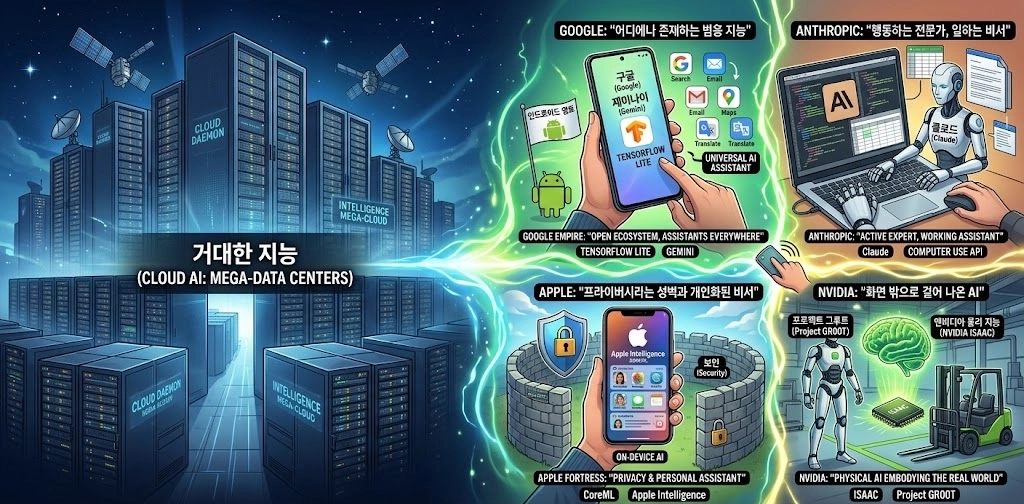
Google’s Empire: “Ubiquitous General Intelligence”
Google, with its vast Android territory, is conquering as much ground as possible by leveraging freely available tools (TensorFlow Lite) and its own AI, ‘Gemini’.
- Investment Point: Google is embedding AI assistants into services we use daily, such as search engines, email, and maps. It aims to make Google’s intelligence assist our daily lives regardless of the device used, adopting an ‘open ecosystem’ strategy to encourage developers worldwide to create new assistant services on Google’s software environment.
Anthropic’s Claude: “An Acting Expert, A Working Assistant”
Anthropic, a strong rival to OpenAI, is leveraging large-scale investments from Amazon and Google to introduce ‘intelligence that mimics human work methods’ beyond simple conversation.
- Investment Point: Claude’s strength lies in its ‘Computer Use’ capability. Beyond merely writing text, it directly performs complex computer tasks for us, moving the mouse and clicking like an assistant. Especially ultra-lightweight models like ‘Haiku’ are highly intelligent yet very light and fast, making them likely to become the standard for ‘practical agents’ that assist with tasks in real-time on our PCs or mobile phones.
Apple’s Fortress: “The Wall of Privacy and Personalized Assistants”
Apple will build the strongest fortress by combining its powerful iPhone hardware with its dedicated software, ‘CoreML’.
- Investment Point: Apple’s real weapon is an ‘assistant who knows me better than I know myself.’ It processes the most sensitive personal information, such as my photos, messages, and schedule, only within the device (on-device AI) without sending it to external servers. By providing the safest assistant that works only for me within the strong fortress of “security,” it prevents users from leaving the iPhone ecosystem.
NVIDIA’s Physical Intelligence: “AI Stepping Out into the Field”
NVIDIA is now moving beyond being a chip manufacturer, designing the brain of ‘physical AI’ that enables robots to understand and move in the physical world.
- Investment Point: NVIDIA’s future lies in penetrating beyond data centers into factories, logistics, and even home robots. Through robot foundation models like ‘Project GR00T,’ software gains a physical body (robot) to act directly. This will be the most powerful form of Edge AI warfare, where intelligence from the virtual world takes control of ‘bodies’ in the real world.
5. Smart Action Plan for Successful Investment
Shouldn’t We Focus on Companies That Have Completed the ‘Intelligence Virtuous Cycle (Data Feedback Loop)’?
The question of “will the cloud win, or will the devices in our hands win?” is no longer important. True profits come from how well the ‘circulation’ between these two functions.
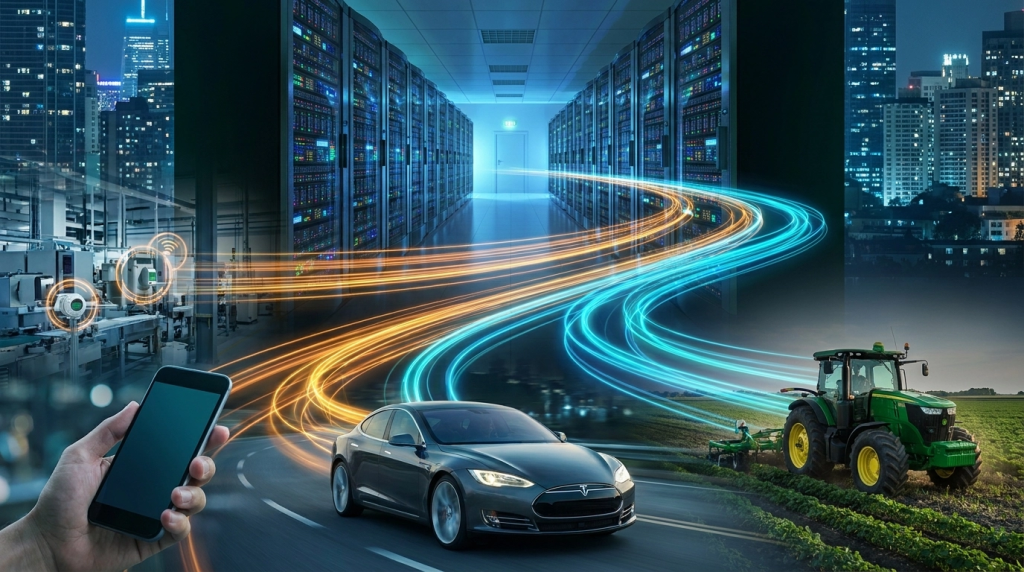
- Formula for Success: Devices around us (edge) collect data → send it to a central server (cloud) to upgrade intelligence → then send it back down to the devices to make them smarter. This structure must be in place.
- Real-world Examples: Tesla’s cars collecting road data to improve autonomous driving performance, or agricultural machinery company ‘John Deere’ improving farming algorithms with data collected from tractors, are good examples.
Shouldn’t we be prepared to look for companies that don’t just sell a product and stop there, but have a business that gets smarter after the sale? (Google, Anthropic, Tesla, …)
Shouldn’t We Look for Infrastructure That Unifies a ‘Fragmented Environment’?
There are trillions of devices worldwide, and each type is different. Embedding and managing AI in these countless devices is truly a ‘war against complexity’.
- Opportunity for Profit: Why not pay attention to platform companies that solve these complex problems? They act like the technical standards that connected all websites in the early days of the internet.
- Investment Point: When everyone went to mine for gold, the people who made the most reliable money were those who sold ‘pickaxes and jeans.’ The pickaxe of the Edge AI era will be software infrastructure that manages countless devices as one.
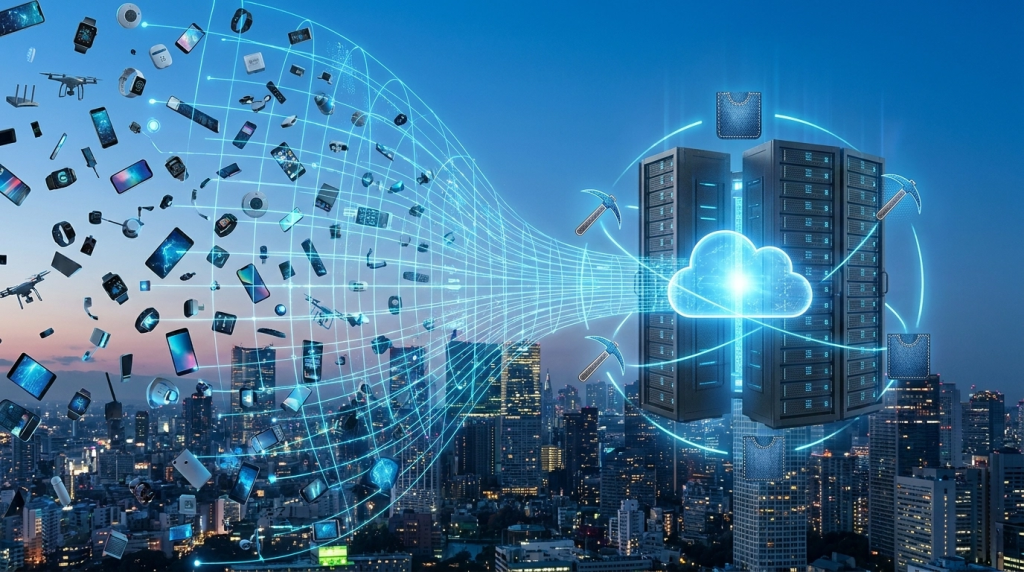
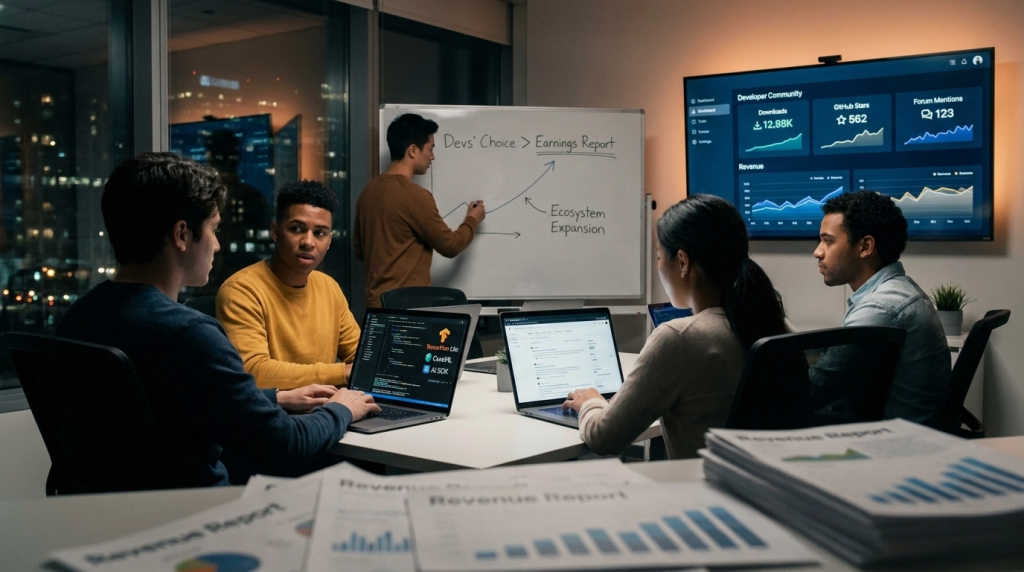
It Seems Necessary to Read ‘Developers’ Choices’ Before Sales Reports.
A company’s quarterly sales performance is merely a record of the past. The future stock price depends on which tools smart developers worldwide are choosing at this very moment.
- Key Indicator: It is important to observe which company’s software tools (e.g., Google’s TensorFlow Lite, Apple’s CoreML, etc.) are more frequently mentioned and utilized within the developer community.
- Investment Point: The winners of the future are recorded not in analyst reports, but first in the code of experts working in the field. I believe that the tools people become accustomed to will likely become that company’s strong market dominance (moat).