Google I/O 2026 – Future of AI and Investment Insights


Last week, the eyes of the global IT industry were on Google’s headquarters in Mountain View, USA. This was because Google I/O 2026 was held. This event was not merely a showcase for Google’s new technologies.
It was a monumental event where Alphabet declared to the world that it had completely moved beyond the simple ‘exploration and assistance’ phase of artificial intelligence (AI) technology, entering the stage of ‘Agentic AI,’ which genuinely acts autonomously, and ‘Full-Stack AI,’ which integrates a physical ecosystem encompassing everything from hardware to software.
Today, we will succinctly summarize the key announcements from Google I/O 2026 and provide an in-depth analysis from the perspective of global financial markets and investors. What future is Google envisioning, and what investment opportunities are hidden within it?
1. Google I/O 2026 Key Announcements Summary
The core of this I/O 2026 was to demonstrate how ‘Gemini’ is evolving from a ‘secretary’ to an ‘Agent’ in our lives. We have summarized the announcements by key areas.
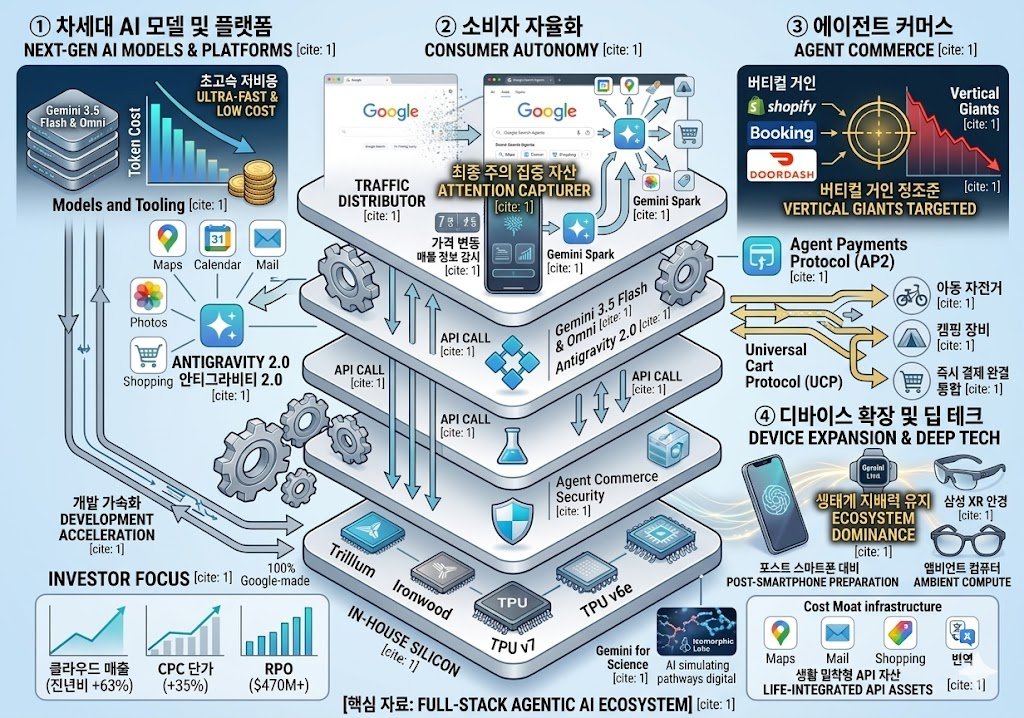
① Next-Generation AI Models and Developer Platform (AI Core)
Google has upgraded the foundational models and platforms of its AI ecosystem, making them more powerful and efficient.
Gemini 3.5 Flash and Omni Full Deployment: ‘Gemini 3.5 Flash,’ boasting a 4x faster response speed than its predecessor, has been fully deployed as the default model. It demonstrates overwhelming efficiency in multi-step tool processing and visual understanding. Additionally, ‘Gemini Omni,’ a world model capable of understanding real-world physical laws (gravity, friction, etc.) and directly editing multiple formats such as text, images, audio, and video through real-time conversation, was also unveiled.
Antigravity 2.0 Platform: ‘Antigravity 2.0,’ a runtime and development environment dedicated to autonomous agents, has been released. Developers can now deploy autonomous agents in an isolated sandbox environment with a single API call, without complex backend management, signaling the full-scale advent of the agent development era.
② Autonomization of Consumer Lifestyles (Agentic AI)
The Google services we use daily are undergoing revolutionary changes with the introduction of AI agents.
Gemini Spark: This is a permanent personal assistant system that operates 24/7 in the background, even when the device is turned off or the browser is closed. It autonomously handles tasks such as drafting email replies, coordinating calendars, and generating work guides for the user.
Search Bar Overhaul After 25 Years: The search bar has been revamped to naturally process queries combining multiple tabs, videos, and images. Notably, the ‘Search Agents’ (Information Agents) feature, which monitors price changes, ticket availability, and property listings to automatically generate reports, is now built-in.
③ Agent Commerce and Open Protocols (Agent Commerce)
The era of ‘Agent Commerce,’ where AI agents handle shopping and even payments on our behalf, is dawning.
Universal Commerce Protocol (UCP): This is an open-source commerce standard co-designed with Amazon, Meta, Microsoft, Stripe, and others, enabling autonomous agents to complete commercial transactions in a secure and consistent format.
AP2 & Universal Cart: Infrastructure (AP2) is being established, allowing agents to directly track product prices and even handle proxy payments within a secure budget limit. Users can manage products from all shopping malls collectively within Google’s ecosystem through a single ‘Universal Cart.’
④ Device Expansion and Advanced Scientific Research (Hardware & Deep Tech)
AI is moving beyond smartphones to glasses, and into the heart of scientific research.
Samsung·Gentle Monster Joint XR Glasses: ‘Intelligent eyewear’ featuring a voice recognition assistant (Gemini Live) and real-time object recognition (Nano Banana) technology will be released this fall. Wearing the glasses, users can navigate using only visual information or order food via a delivery app.
Gemini for Science: In collaboration with Isomorphic Labs, AI simulations are used to digitally simulate the pathways causing cancer and rare immune diseases at digital speeds. This is dramatically shortening the timeline for medical R&D.
2. Analysis of Google I/O 2026 from an Investor’s Perspective
Now for the most crucial part.
How will this announcement impact Google (Alphabet)’s corporate value and stock price? We will analyze four key points from an investor’s perspective.
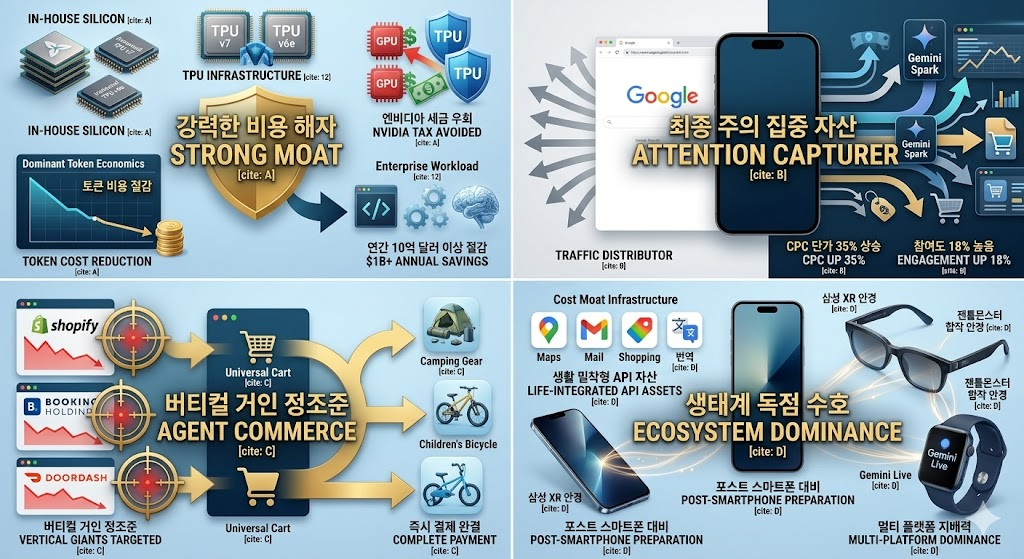
A. A Powerful Cost Moat Created by In-House Silicon (TPU) and 3.5 Flash
Amidst the AI CAPEX (capital expenditure) competition among tech companies, which is a major concern for investors, Google has demonstrated unparalleled cost competitiveness.
Bypassing the Nvidia Tax: While competitors struggle with GPU procurement costs, Google has made full infrastructure independence a reality based on its own custom chip TPU (Trillium and Ironwood) ecosystem. Gemini 3.5 is also trained and served 100% on its proprietary TPUs.
The Triumph of Token Economics: The ultra-fast, low-cost Gemini 3.5 Flash model offers compelling unit economics, allowing enterprise customers to save over $1 billion annually if they migrate 80% of their workloads. This forms the cornerstone of fundamentals that will further boost Google Cloud’s market share. (Q1 2026 Cloud revenue surpassed $20 billion, +63% year-over-year growth)
Expansion into Infrastructure Business: The establishment of a 500MW dedicated TPU NeoCloud with Blackstone (valued at $5 billion) and a long-term partnership with Anthropic demonstrate that Google is transforming its stature from a mere model vendor to a ‘silicon hardware leasing giant.’
B. Paradigm Shift in Search Advertising Model: From Traffic Distributor to Attention Capturer
Concerns about a decline in traditional advertising revenue due to the introduction of AI search were unfounded.
Overcoming Zero-Click Risk: There were concerns that the introduction of AI Overviews and autonomous information agents would lead to a decrease in website link click-through rates (CTR).
Confirmed Increased CPC: However, actual data tells a different story. When ads were placed on AI Mode results pages, engagement was 18% higher compared to traditional plain text search ads, and the cost-per-click (CPC) increased by an impressive 35%. Google is evolving from a mere intermediary that simply passed on traffic to an ‘Attention Capturer’ that finalizes purchase decisions within its own platform, successfully stimulating advertisers’ willingness to pay.
C. Agent Commerce Targeting Vertical Giants (Shopify, Booking, etc.)
As Google’s agents become the ‘final gateway’ for shopping, existing e-commerce and intermediary platforms are facing threats.
Google as a Purchasing Agent: Universal Cart and the AP2 protocol are game-changers for the commerce industry. When purchasing items like camping gear, users no longer need to browse multiple sites; a Google agent will instantly complete the payment via Google Pay, incorporating optimal discounts (perks).
Strengthening Lock-in: The dissolution of these distribution barriers poses a direct threat to the inbound traffic of vertical intermediary apps like Shopify, Booking Holdings, and DoorDash. Consequently, advertisers will inevitably have to allocate higher fixed budgets to Google’s autonomous execution advertising system.
D. Hardware Gateway Competition to Protect On-Device Ecosystem Dominance
Google’s on-device AI strategy, in preparation for the post-smartphone era, is also robust.
- Leader in the Ambient Compute Era: The smart glasses announced by Google with Samsung and others represent a strong defensive strategy against Meta’s early lead in the wearable AI hardware market. As we transition from the mobile internet era of looking at smartphone screens to an era of wearing devices, Google’s unique assets of lifestyle-integrated APIs (Maps, Mail, Shopping, Translate, etc.) make its hardware competitiveness irreplaceable. This ensures that Android’s dominance will naturally transfer to wearables, maintaining multi-platform control.
3. Conclusion: Practical Summary for Investors
As of Google I/O 2026, Alphabet (GOOGL) has secured its position as an “integrated giant that directly owns the most complete, affordable, and powerful artificial intelligence infrastructure (ASIC), flawlessly monopolizing the global pathways of information search and commercial distribution with AI agents.”
In the short term, there might be concerns about the erosion of financial profit margins due to large-scale AI infrastructure capital expenditures (CapEx target adjusted upwards to $180 billion-$190 billion). However, the already secured $462 billion cloud backlog and Gemini 3.5 Flash’s ability to introduce groundbreaking annual server cost savings of $1 billion will safely defend against this.
Therefore, for investors building portfolios, Alphabet is sufficiently evaluated as a key leading stock that can enjoy the powerful autonomous business fruits of Big Tech AI under the most reasonable valuation (P/E multiple and margin defense capability).
In the era of AI agents ushered in by Google, what are your thoughts?