The Reality of the Quantum Computer Hegemony Race and the Practical Investment Landscape Chosen by Capital

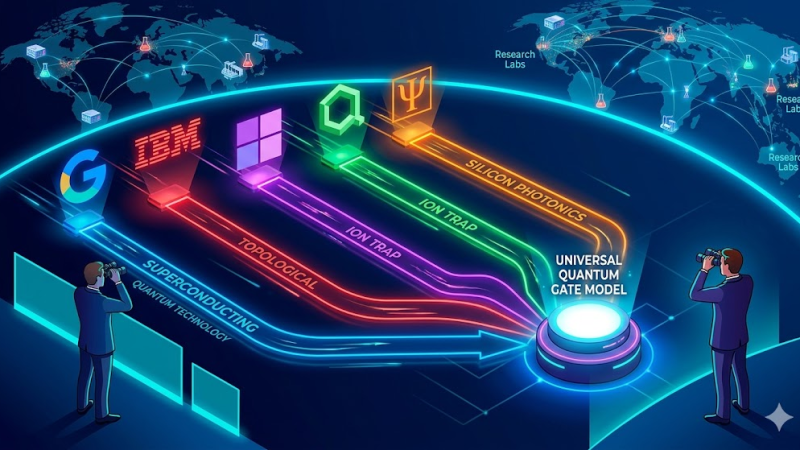
Quantum computing, which is shaking up the information technology market, is moving beyond the simple research lab stage and entering a practical commercialization trajectory.
The massive capital injection led by the U.S. government and the fierce design standard competition among global big tech companies are intertwining with the reorganization of the Western world’s supply chain, forming a significant macro signal. As the explosive growth of the artificial intelligence market hits the physical limits of power infrastructure and silicon semiconductors, shrewd investors have already begun to deploy capital into the real assets that will lead the next paradigm.
Through this article, readers will gain exactly three key insights today:
[Comparison of Sector-Specific Strengths in 5 Quantum Architecture Methods]
Identify the technological breakthroughs and monopolistic power of the five quantum architecture standards adopted by global big tech companies and select the infrastructure companies that have gained the upper hand.[Proof of Actual Revenue Growth and Cash Reserves]
Beyond mere technological expectations, identify practical investment opportunities that have demonstrated contract values and cash mobilization capabilities significantly exceeding Wall Street’s forecasts.[Geopolitical Security Hegemony and Benefits from Mandatory Regulatory Timelines]
Understand the reality of capitalist supply chain reorganization amidst the U.S.-China security conflict and grasp the beneficiary areas resulting from the complete replacement cycle of national security communication networks.
[Onboarding] Quantum Computing
Smartphones we use daily and the world’s most expensive supercomputers for weather forecasting all operate based on bits, where electricity flowing represents 0 and no electricity represents 1.
When finding an exit in a complex maze, these classical computers systematically block each path one by one, gradually walking through to find the correct answer. However, when the number of possibilities increases to hundreds of millions or trillions, such as simulating a superconducting phenomenon at -273 degrees Celsius or a complex protein molecule in a virtual space, the calculation sequence table becomes too long, hitting a physical wall where the computer simply freezes.
Quantum Computing is a new technology that fundamentally breaks through this limit by utilizing the unique physical laws of the microscopic world. Just as a coin can be heads or tails when lying flat, but simultaneously possesses both properties when spinning, a qubit, the core unit of a quantum computer, creates a superposition state that holds both 0 and 1 simultaneously.
Added to this is the property of entanglement, where two quantum particles, no matter how far apart, are connected faster than light and react in real-time. Thanks to this, quantum computers can explore all paths of a maze simultaneously, achieving transcendent computational speeds that solve intractable problems in just a few minutes that would take classical computers hundreds of millions of years.
1. Big Tech’s Dissection: 5 Quantum Architecture Standards and Ecosystem Domination Strategies
To realize quantum computers in the real world, global big tech companies are competing for standards, each advocating different raw materials and control technologies. From an investor’s perspective, this is a critical turning point that will determine future massive monopolistic platform profits, much like the VHS vs. Betamax competition for videotapes or the smartphone operating system competition in the past. Currently, the market is fragmented into five major camps—superconducting, topological, ion trap, silicon photonics, and others—vying for leadership.
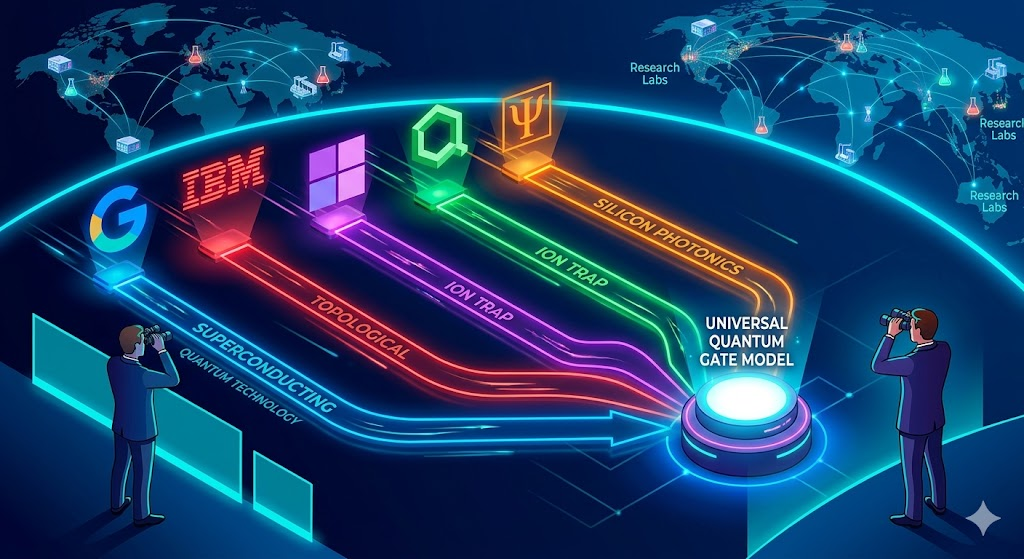
The first method to take the lead is the superconducting approach. GOOG (Alphabet) recently announced its next-generation 105-qubit quantum chip, ‘Willow,’ demonstrating in the academic journal Nature an innovative technology where the error rate is more than halved as qubits are densely increased and combined.
IBM (International Business Machines) also adopted the superconducting method, already opening over 433 physical qubit chips to the cloud, and through its free development tool, ‘Qiskit,’ it has preemptively secured over 550,000 developers worldwide, holding an unrivaled first place in ecosystem dominance.
On the other hand, MSFT (Microsoft) is pioneering the topological Majorana method, designing chips to be inherently robust against external stimuli and noise. Their developed ‘Majorana 1’ chip demonstrated overwhelming efficiency, extracting 28 stable core logical qubits from just 112 physical qubits. This is an original strategy to fundamentally prevent the waste of auxiliary equipment consumed for error correction.
The camp leveraging hardware precision and scalability as its weapon is also fiercely catching up. The ion trap method, led by IONQ (IonQ) and Quantinuum, controls individual atoms suspended in space, making it easy to operate in near-room temperature environments and ensuring very clean computations. Finally, the silicon photonics method, led by PsiQuantum, transmits photons (light particles) as signals, completing the commercial foundation for mass production by utilizing the production lines of commercial semiconductor foundries like GlobalFoundries.
Investment Point: The quantum standard competition should be approached by narrowing down to hardware camps that have proven technological precision and platform companies that have already secured a distribution network by acquiring an infrastructure of 550,000 developers. Original Nature Journal Article on Google Willow’s Achievements
2. Capital’s Practical Deployment: Companies Proving Commercial Leap Beyond Wall Street’s Expectations
In the investment market, what’s more important than technological greatness is the ability to shrewdly convert it into money. If past quantum computing investments were venture capital betting on a decade later, as of May 2026, Wall Street is coldly deploying funds only to companies that demonstrate contract values and cash flow in immediate quarterly results. At the center of the practical investment landscape chosen by capital are pure-play quantum companies that have proven actual revenue growth.
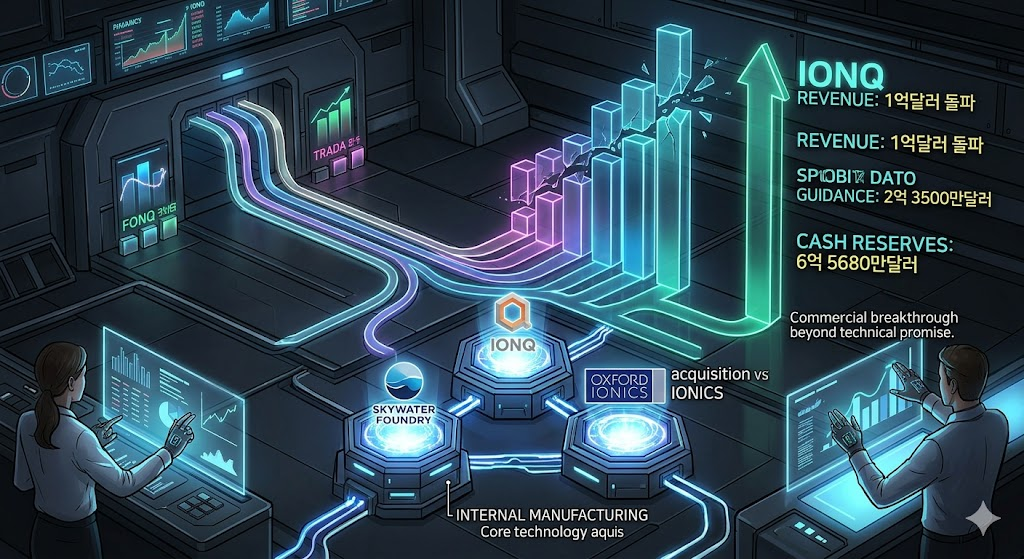
The company demonstrating the most brilliant commercial leap is IONQ (IonQ).
IonQ not only became the first pure-play quantum company in history to break the $100 million annual revenue barrier but also projected future revenue guidance of $235 million, significantly exceeding Wall Street’s forecast of $191 million. A large-scale procurement contract worth $100 million with the U.S. Department of Defense and a subscription-based billing model through clouds like Amazon and Microsoft have served as powerful catalysts.
IonQ’s real weapon is its formidable cash reserves, totaling an impressive $656.8 million. Based on this financial strength, it acquired the semiconductor foundry company SkyWater Technology for $1.8 billion and directly acquired Oxford Ionics, a company with core precision control technology, for $1.1 billion, establishing a dominant position by completely monopolizing and internalizing its hardware manufacturing network.
Another listed company, QBTS (D-Wave Quantum), targeted niche markets by immediately solving specific business challenges for companies, such as designing optimal routes in finance, logistics, and manufacturing. It secured substantial commercial contracts worth $30 million with large corporations, earning recognition as a powerful problem-solver in the market. Companies that have begun to generate such practical commercial contracts and revenue are rapidly absorbing capital in the quantum sector.
Investment Point: Do not be swayed by vague technological promotions; instead, verify whether companies have secured significant order backlogs by entering global cloud infrastructure and possess sufficient cash reserves to internalize hardware. IonQ Quarterly Results and Guidance
3. Hegemony Race and Regulatory Timeline: The Biggest Beneficiary of the US-China Security Supply Chain Reorganization
Quantum computing is not merely an industrial revolution but a formidable weapon that can entirely neutralize national security systems. This is due to the scenario where hostile forces currently collecting and storing Western military secrets and bank financial data could collectively decrypt them once high-performance quantum computers are completed. As a result, the United States and China have declared quantum computing a frontline of national security and are pouring astronomical funds into the field.
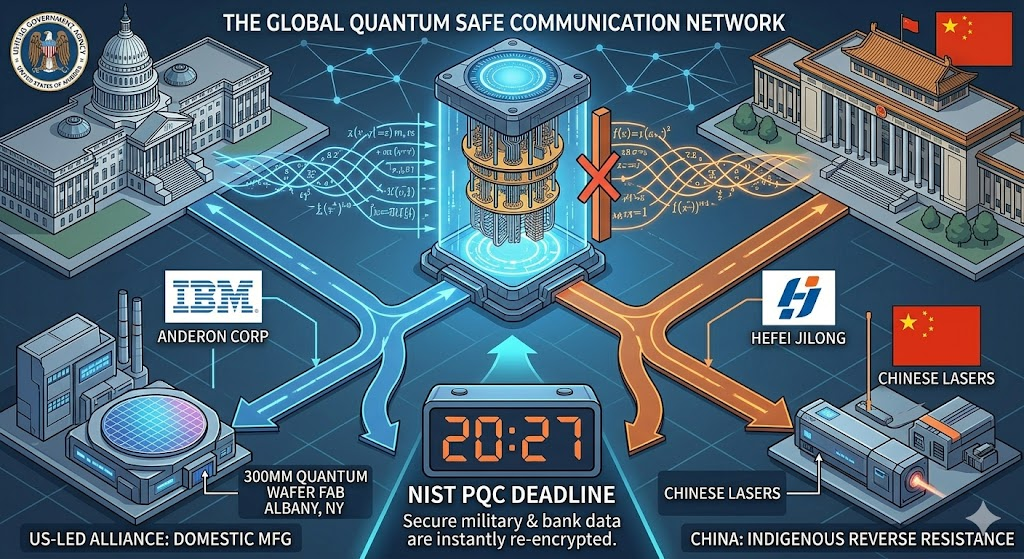
The U.S. Department of Commerce announced support for a total of $2.013 billion in CHIPS Act incentives to nine quantum companies, overtly signaling a ‘state-led technological alliance.’
Of this funding, $1 billion is allocated to IBM’s new entity, ‘Andarone,’ to build the world’s first quantum-dedicated 300mm wafer factory in Albany, New York. The plan is to mass-manufacture all Western quantum hardware substrates on U.S. soil, completely excluding China.
Conversely, strong U.S. sanctions have also sparked a ‘localization counter-attack’ in China. With access to U.S.-made precision cryogenic cooling equipment blocked, Chinese companies like ‘Hefei Jiulong’ began localizing and supplying core coolers. Furthermore, Chinese-made precision quantum experimental laser equipment has, in turn, been sold to over 100 sets to Harvard University in the U.S., rapidly achieving supply chain self-reliance.
From an investor’s perspective, the fastest and most certain opportunity lies in the mandatory regulatory timeline for ‘Post-Quantum Cryptography’ (PQC). The U.S. National Institute of Standards and Technology (NIST) has finalized complex lattice-math-based cryptographic standards that quantum computers cannot break. The U.S. National Security Agency (NSA) is implementing legal timeline regulations requiring the complete replacement of military communication networks and the entire executive branch’s communication security networks with this new cryptographic system by early 2027, providing a huge mandatory replacement cycle bonus to security companies possessing related technologies.
Investment Point: Read the trend of hardware supply chain completion being reorganized around the U.S. mainland, and focus on the software sector that will directly benefit from the legally mandated PQC adoption regulations by early 2027. NIST PQC Standard Guidelines
4. The Key to Transcendent AI: An Essential Engine for Moving Beyond AGI to ASI
With the rapid development of artificial intelligence recently, a grand discourse has formed around whether quantum computers hold the key to reaching the superintelligence stage, where intelligence surpasses that of humans. To state the conclusion upfront, Artificial General Intelligence (AGI), which handles human-level general tasks, can be sufficiently achieved with current large-scale GPU cluster acceleration.
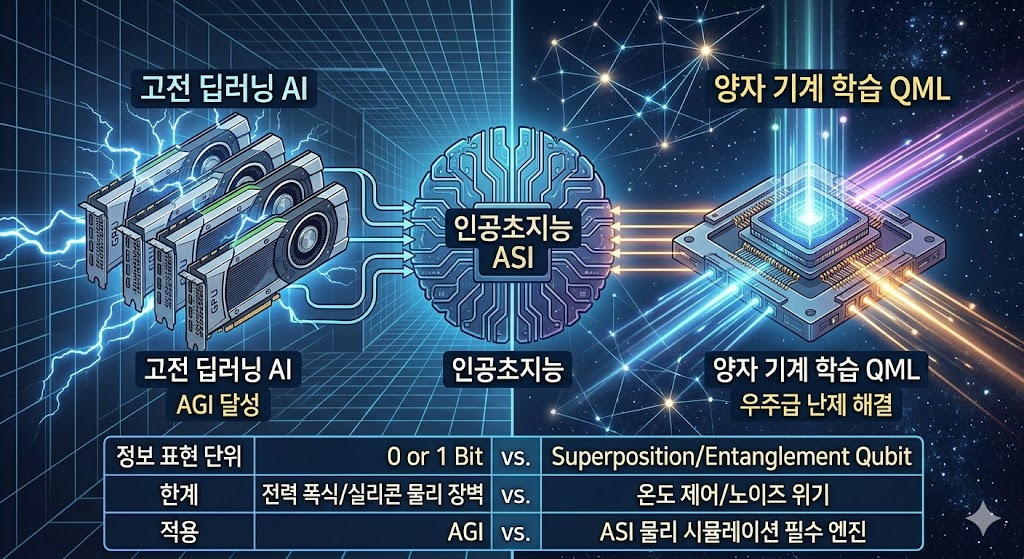
However, quantum computing is essential for Artificial Superintelligence (ASI) that transcends human common sense and recreates physics. Areas such as climate simulations for new renewable energy to combat global warming or perfectly synthesizing room-temperature superconductors in virtual space simply do not have the computational efficiency with existing computer bit structures. Even simulating a single caffeine molecule with just 95 electrons without error would consume more classical bits than all the atoms in the entire universe.
Ultimately, the future intelligence system will evolve into a ‘hybrid combination model’ of classical and quantum computers. If classical AI learns quantum computer noise and malfunctions in real-time to precisely calibrate system errors by more than 3.5 times, quantum hardware will immediately elevate high-dimensional data into the $ 2^N $ Hilbert space inherent in $ N $ qubits, completing a mutually reinforcing structure that accelerates the solution of cosmic-level complex problems.
| Comparison Item | Classical Deep Learning-based AI | Quantum Machine Learning (QML) |
|---|---|---|
| Information Representation Unit | Bits with states of 0 or 1 | Qubits with superposition and entanglement, where 0 and 1 overlap simultaneously |
| Key Limitations | Extreme power consumption for trillion-scale acceleration and physical miniaturization barriers for silicon | Extremely sensitive temperature control and signal degradation due to noise |
| Necessity of Application | Sufficient for general text logic implementation, daily task automation, AGI development | Essential engine for physical molecular bonding modeling, cosmic-scale decryption, and physical simulation for transcendent ASI |
5. Next Step
As a result of precise analysis of the quantum computer hegemony race and the practical investment landscape, now is the opportune time to move beyond vague technological fantasies and deploy capital into supply chains and regulatory timelines that show tangible numbers. Here is a practical guide to help readers successfully allocate their investment assets:
Three Practical Guides for Readers (Next Step):
• Metrics to Check: Status of the U.S. National Institute of Standards and Technology’s mandatory Post-Quantum Cryptography transition timeline implementation and quarterly order backlog growth trends of listed companies like IonQ.
• Actions to Take: Review existing AI semiconductor-centric portfolios and selectively allocate assets through staggered purchases into core hardware stocks within the U.S. mainland quantum supply chain, where U.S. government funding is concentrated, and cybersecurity stocks that will benefit from legally mandated regulations.
• Key Keywords to Search: Post-Quantum Cryptography, Logical Qubit, Quantum Machine Learning